

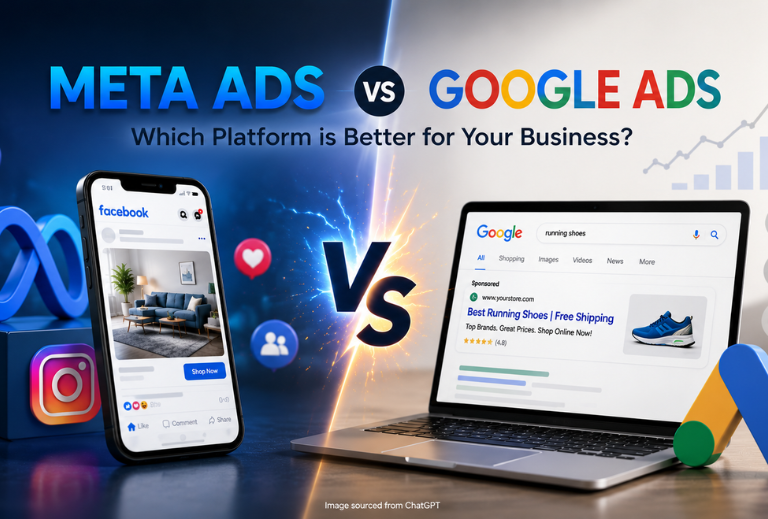
If you’re planning to invest in digital advertising, one of the biggest questions you’ll face is: Should you choose Meta Ads or Google Ads? Both platforms are industry leaders and can generate exceptional results, but they work in very different ways.
Google Ads helps you reach users actively searching for your products or services, making it ideal for generating high-intent leads and conversions. Meta Ads (Facebook and Instagram Ads), on the other hand, excel at building brand awareness, engaging audiences, and creating demand through highly targeted visual campaigns.
So, which platform is better for your business?
The answer depends on your goals, target audience, budget, and industry. In this comprehensive guide, we’ll compare Meta Ads vs Google Ads across key factors like cost, targeting, ROI, lead quality, and business suitability to help you make the right decision.
Meta Ads vs Google Ads: At a Glance
| Feature | Meta Ads | Google Ads |
|---|---|---|
| Best For | Brand Awareness & Engagement | Lead Generation & Sales |
| Audience Intent | Discovery-Based | Search Intent-Based |
| Platforms | Facebook, Instagram, Messenger | Google Search, YouTube, Display, Maps |
| Targeting | Interests, Behaviors, Demographics | Keywords, Search Intent, Location |
| Average CPC | Lower | Higher (depending on industry) |
| Ideal For | Ecommerce, Lifestyle, Fashion | Local Services, B2B, Healthcare |
| Conversion Stage | Top & Middle Funnel | Bottom Funnel |
What Are Meta Ads?
Meta Ads are paid advertisements that appear across Facebook, Instagram, Messenger, and the Meta Audience Network. Rather than waiting for customers to search, Meta introduces your products or services to users based on their interests, demographics, online behavior, and engagement history.
This makes Meta Ads an excellent platform for businesses looking to create awareness, grow their audience, and nurture potential customers.
Key Benefits of Meta Ads
- Advanced audience targeting
- Visually engaging ad formats
- Cost-effective reach
- Excellent remarketing capabilities
- Lookalike audience targeting
- Strong ecommerce integrations
Popular ad formats include image ads, videos, Stories, Reels, Carousel Ads, Collection Ads, and Instant Experience Ads.
What Are Google Ads?
Google Ads is Google’s advertising platform that displays ads across Google Search, YouTube, Google Display Network, Shopping, Gmail, and Google Maps.
Unlike Meta Ads, Google Ads target users based on what they’re actively searching for. This means businesses can appear in front of customers who already have purchase intent.
For example, if someone searches “best digital marketing agency in Mumbai,” Google Ads can display your business at the top of the search results.
Key Benefits of Google Ads
- High-intent traffic
- Fast lead generation
- Local targeting
- Conversion-focused campaigns
- Comprehensive performance tracking
- Multiple campaign types including Search, Shopping, Video,
- Display, and Performance Max
Meta Ads vs Google Ads: Detailed Comparison
1. Customer Intent
One of the biggest differences between the two platforms is user intent.
Meta Ads
People browse Facebook and Instagram primarily to consume content, connect with friends, or discover new brands. They aren’t always looking to make an immediate purchase.
Meta Ads create demand.
Google Ads
Google users are actively searching for answers, products, or services. This means they’re often much closer to making a buying decision.
Google Ads capture existing demand.
Winner: Google Ads
2. Audience Targeting
Meta Ads
Meta’s targeting capabilities include:
- Interests
- Age
- Gender
- Education
- Job titles
- Purchase behavior
- Custom Audiences
- Lookalike Audiences
- Website visitors
This makes Meta exceptionally powerful for reaching new customers.
Google Ads
Google focuses on:
- Keywords
- Search intent
- Device
- Geographic location
- Audience segments
- Customer Match
- In-market audiences
Google ensures your ads appear when people are actively looking for what you offer.
Winner: Tie (Different strengths)
3. Advertising Cost
Budget is often a deciding factor.
Meta Ads
Generally offers:
- Lower Cost Per Click (CPC)
- Lower Cost Per Thousand Impressions (CPM)
- Affordable brand awareness campaigns
Google Ads
Costs vary significantly depending on keyword competition.
Industries like finance, legal, healthcare, insurance, and real estate usually experience higher CPCs due to strong competition.
Winner: Meta Ads (Lower advertising costs)
4. Lead Quality
Generating leads is one thing—generating qualified leads is another.
Google Ads typically deliver better-quality leads because users already know what they want and are searching for a solution.
Meta Ads often produce higher lead volumes, but businesses may need additional follow-ups and nurturing before those leads convert.
Winner: Google Ads
5. Brand Awareness
If your objective is to introduce your brand to new audiences, Meta Ads have a clear advantage.
Visual content, videos, Stories, and Reels create engaging experiences that help businesses build recognition and trust over time.
Google Search Ads are primarily text-based and are more focused on capturing demand than creating it.
Winner: Meta Ads
6. Ecommerce Performance
Both platforms play important roles in ecommerce marketing.
- Meta Ads are ideal for:
- Product discovery
- Fashion brands
- Lifestyle products
- Dynamic catalog ads
- Retargeting abandoned carts
Google Ads are ideal for:
- Google Shopping campaigns
- Search campaigns
- High-intent buyers
- Product comparison searches
Most successful ecommerce brands combine both platforms for maximum results.
Winner: Both
7. Local Business Marketing
Local businesses often see better results with Google Ads because users actively search for nearby services.
Examples include:
- Dentist near me
- Car repair near me
- SEO agency in Mumbai
- Best salon nearby
- AC repair services
Google Maps Ads also help businesses increase local visibility.
Winner: Google Ads
8. Remarketing
Remarketing helps reconnect with users who have already interacted with your business.
Meta Ads
Excellent for remarketing:
- Website visitors
- Instagram engagement
- Facebook page interactions
- Abandoned shopping carts
- Video viewers
Google Ads
Allows remarketing across:
- Search
- YouTube
- Display Network
- Gmail
When used together, both platforms create a powerful remarketing ecosystem.
Which Platform Should You Choose?
Choose Meta Ads if you want to:
- Increase brand awareness
- Promote visually appealing products
- Grow your social media audience
- Launch new products
- Build customer engagement
- Retarget visitors
Choose Google Ads if you want to:
- Generate qualified leads
- Increase phone calls
- Drive website enquiries
- Capture local customers
- Improve online sales
- Target users with purchase intent
Why the Best Strategy Often Includes Both
Many businesses mistakenly believe they must choose one platform over the other.
In reality, Meta Ads and Google Ads complement each other throughout the customer journey.
A typical buying path may look like this:
1.A user discovers your brand through a Facebook or Instagram ad.
2.They visit your website but don’t convert.
3.A few days later, they search for your business on Google.
4.Your Google Search Ad appears.
5.They return to your website and become a customer.
This multi-touchpoint strategy improves trust, increases conversion rates, and maximizes advertising ROI.
Best Practices for Higher ROI
To get the most from your advertising budget:
- Define measurable campaign goals.
- Install Meta Pixel and Google Tag Manager for accurate tracking.
- Create dedicated landing pages for each campaign.
- Continuously A/B test headlines, creatives, and calls to action.
- Monitor conversions instead of focusing only on clicks.
- Use remarketing campaigns to recover lost visitors.
- Optimize campaigns regularly based on performance data.
Frequently Asked Questions
Which platform is better for small businesses?
If you need immediate leads, Google Ads is often the better choice. If you’re building a brand or selling visually appealing products, Meta Ads can deliver excellent value.
Are Meta Ads cheaper than Google Ads?
In many industries, yes. Meta Ads usually have lower CPCs and CPMs, making them more affordable for awareness campaigns.
Which platform has better ROI?
ROI depends on campaign quality, targeting, landing pages, and your business goals. Google Ads often generate higher-quality leads, while Meta Ads can produce lower-cost conversions for awareness and ecommerce campaigns.
Can I run both Meta Ads and Google Ads together?
Absolutely. Using both platforms creates multiple customer touchpoints, strengthens brand visibility, and often results in better overall marketing performance.
Final Verdict
There is no universal winner in the Meta Ads vs Google Ads debate. The right choice depends on what you want to achieve.
If your focus is brand awareness, audience engagement, and product discovery, Meta Ads are an excellent investment. If your priority is capturing high-intent customers, generating qualified leads, and increasing conversions, Google Ads are typically the stronger option.
For most businesses, combining both platforms delivers the best results. Meta Ads help create demand and build relationships, while Google Ads capture customers who are ready to take action.
Grow Your Business with Velocity Consultancy
Choosing the right advertising platform is only the first step. Success depends on campaign strategy, audience targeting, creative optimization, and continuous performance improvements.
At Velocity Consultancy, we specialize in data-driven Google Ads, Meta Ads, and Performance Marketing strategies that help businesses generate quality leads, increase sales, and maximize return on investment. Whether you’re a startup, local business, ecommerce brand, or enterprise, our experts create customized campaigns tailored to your goals.
Ready to scale your business with smarter advertising? Contact Velocity Consultancy today and let our digital marketing specialists build a results-driven advertising strategy that delivers measurable growth.


 15+ Years Of Expertise
 100% Confidential