

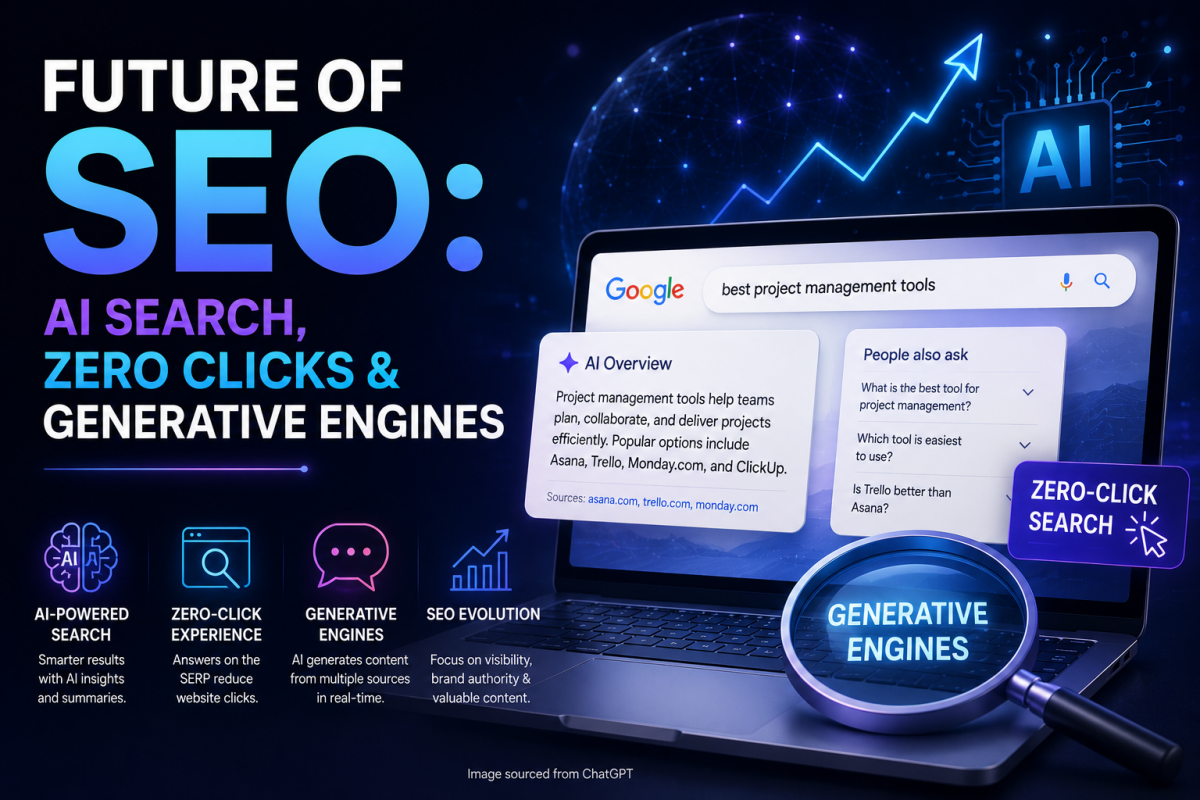
Search is no longer simply about typing a keyword into Google and choosing one of ten blue links. In 2026, users can receive direct answers from Google AI Overviews, ChatGPT Search, Perplexity, Gemini, Microsoft Copilot, and other AI-powered platforms.
For businesses, this does not mean SEO is disappearing. It means the definition of search visibility is expanding.
The future of SEO in 2026 is increasingly about being discoverable not only in traditional rankings but also within AI-generated answers, citations, recommendations, featured snippets, and conversational search experiences.
Google itself continues to recommend established SEO fundamentals for its AI search experiences, while emphasizing unique, useful content and strong page experience.
So, what should businesses do differently? Let’s explore.
What Does the Future of SEO Look Like in 2026?
Quick Answer: The future of SEO combines traditional search optimization with AI SEO, Answer Engine Optimization (AEO), Generative Engine Optimization (GEO), entity authority, and user-focused content.
Traditional rankings still matter, but businesses increasingly need to consider whether their information can be understood, trusted, retrieved, and cited by AI systems.
The shift can be summarized simply:
| Traditional SEO | SEO in 2026 |
|---|---|
| Ranking web pages | Ranking + AI visibility |
| Short keyword queries | Conversational queries |
| Organic clicks | Clicks + citations + mentions |
| Keyword optimization | Topic and entity optimization |
| Google-focused | Multi-platform search |
| Blue links | AI answers + links + recommendations |
SEO is therefore evolving rather than becoming obsolete.
Why AI Search Is Changing SEO
Generative AI can synthesize information from multiple sources and present users with a direct response.
For example, someone researching:
“Which digital marketing strategy is best for a small B2B company?”
may no longer need to open several websites individually. An AI search experience can provide an initial comparison and direct the user toward relevant sources for further research.
ChatGPT Search, for example, can search the web and provide timely answers with links to web sources.
Microsoft is moving in a similar direction. Bing describes generative search as using AI and large language models to dynamically generate responses while providing links and sources for further exploration.
For marketers, this creates a new SEO objective:
Don’t optimize only to rank. Optimize to become a trusted source that search and AI systems can confidently reference.
Google AI Overviews and the New Search Results
One of the biggest changes affecting SEO trends in 2026 is the expansion of Google’s generative AI search experiences.
AI Overviews can provide an AI-generated response directly within search results, supported by links that allow users to explore relevant websites.
Importantly, Google says the fundamentals for succeeding in these AI experiences remain familiar: create unique and valuable content, provide a strong page experience, ensure pages are crawlable and indexable, and keep structured data consistent with visible content.
In June 2026, Google also announced dedicated Search Console reporting for generative AI visibility, including AI Overviews and AI Mode, initially rolling it out to a subset of websites.
This highlights an important change in SEO measurement: AI visibility itself is becoming measurable.
What Is Zero-Click Search?
A zero-click search occurs when users get enough information from the search experience that they do not need to visit another website.
Examples can include:
- AI-generated answers
- Featured snippets
- Knowledge panels
- Local results
- Definitions
- Quick-answer features
At first glance, this may sound bad for businesses.
But fewer clicks do not necessarily mean SEO has less value.
A company that repeatedly appears as a trusted source in AI-generated results can still build awareness and authority. And when users do need deeper information, compare providers, request a quote, or make a purchase, strong organic visibility remains valuable.
Google also advises site owners to look beyond raw clicks and consider the value and engagement of visits generated through AI search experiences.
What Is Generative Engine Optimization (GEO)?
Generative Engine Optimization (GEO) refers to improving content so it can participate effectively in AI-generated search and answer experiences.
Microsoft describes GEO in the context of how content contributes to AI-driven answers, citations, reasoning, and outcomes.
Traditional SEO asks:
“How can my page rank for this query?”
GEO adds another question:
“How can my information become a useful and trustworthy source for an AI-generated answer?”
Effective GEO therefore overlaps heavily with good SEO:
- Provide clear answers.
- Demonstrate genuine expertise.
- Use descriptive headings.
- Cover topics comprehensively.
- Keep important facts accurate and current.
- Strengthen entities and contextual relationships.
- Make pages easy to crawl and understand.
- Support claims with credible sources.
- Add original expertise, examples, research, or experience.
GEO should complement SEO rather than replace it.
What Is AEO?
Answer Engine Optimization (AEO) focuses on making information easy for search and answer engines to extract and present as direct answers.
AEO becomes particularly important for conversational and voice-style queries such as:
“What is AI SEO?”
“How does GEO work?”
“Is SEO still worth investing in?”
Content targeting these queries should answer the question clearly before expanding on the explanation.
Useful AEO formats include:
- Concise definitions
- FAQ sections
- Numbered processes
- Comparison tables
- Question-based headings
- Short summaries
These formats improve usability for humans while making important information easier for search systems to interpret.
SEO vs AEO vs GEO
Businesses shouldn’t treat these as three competing strategies.
| Strategy | Primary Goal |
|---|---|
| SEO | Improve organic search visibility |
| AEO | Become a useful direct answer |
| GEO | Improve visibility within generative AI experiences |
The strongest strategy in 2026 combines all three.
Think of it as:
SEO + AEO + GEO = Modern Search Visibility
ChatGPT Search, Perplexity and the Rise of Multi-Platform Search
Google is no longer the only search environment businesses need to think about.
Users increasingly research products, services, companies, and complex questions through conversational AI interfaces.
ChatGPT Search, for instance, provides web-backed answers and source citations that users can open to investigate further.
This means businesses should begin asking:
Does our brand appear when people research our industry through AI assistants?
The goal isn’t to create separate content for every AI platform. Instead, build a strong digital presence with authoritative, technically accessible, well-structured, original content that can perform across multiple discovery environments.
How Businesses Should Prepare for the Future of SEO
A practical AI SEO strategy for 2026 should focus on seven areas.
1. Build Topical Authority
Don’t publish disconnected articles around random high-volume keywords.
Build interconnected topic clusters around your core expertise.
For example, an AI marketing agency could develop content around:
AI Digital Marketing → AI SEO → AEO → GEO → AI Overviews → ChatGPT Search → AI Content Strategy
This creates deeper topical coverage and stronger internal relationships.
2. Create Content That Deserves to Be Cited
Generic AI-generated content offers little competitive advantage.
Add elements competitors cannot easily reproduce:
- First-hand experience
- Expert commentary
- Original examples
- Case studies
- Proprietary data
- Practical frameworks
- Industry-specific insights
Google explicitly warns that generating many AI-assisted pages without adding value can violate its scaled content abuse policies.
3. Optimize for Questions, Not Just Keywords
Target natural-language searches alongside traditional keywords.
Instead of only:
“AI SEO services”
also cover:
“How can AI SEO improve organic traffic?”
This supports traditional SEO, AEO, voice search, and conversational discovery.
4. Strengthen EEAT
Clearly demonstrate Experience, Expertise, Authoritativeness, and Trustworthiness.
Include transparent authorship, accurate information, reputable references, real business details, expert insights, and regularly updated content where appropriate.
Google’s systems aim to reward original, high-quality content demonstrating qualities associated with EEAT regardless of how that content was produced.
5. Don’t Ignore Technical SEO
AI SEO still depends on strong technical foundations.
Your website should remain:
- Crawlable
- Indexable
- Mobile-friendly
- Fast and accessible
- Logically structured
- Internally connected
AI optimization cannot compensate for pages that search engines cannot properly access.
6. Use Structured Data Correctly
Relevant structured data can help search engines understand information about your pages and entities.
However, schema markup should accurately represent content users can actually see. Google specifically recommends ensuring structured data matches visible page content.
7. Measure Visibility Beyond Rankings
SEO reporting should gradually expand beyond rankings and organic sessions.
Businesses should also monitor:
organic conversions, branded searches, AI citations, AI visibility, assisted conversions, engagement, and mentions across relevant search experiences.
Microsoft, for example, introduced AI Performance in Bing Webmaster Tools in 2026 to show publishers how their content is cited across AI-generated experiences.
Is SEO Dead in 2026?
No. SEO isn’t dead; search behaviour is changing.
People still need reliable information, products, services, comparisons, and expert advice. What is changing is how that information reaches them.
The businesses most likely to succeed will move beyond chasing rankings alone and build content ecosystems that are useful to users, understandable to search engines, and credible enough to become sources for AI-generated answers.
Key Takeaway
The future of SEO in 2026 isn’t a battle between traditional search and artificial intelligence.
It is their convergence.
AI SEO, Google AI Overviews, zero-click search, AEO, GEO, ChatGPT Search, Perplexity, and other generative engines are expanding what search visibility means.
The winning strategy remains surprisingly familiar: create genuinely useful content, demonstrate expertise, maintain strong technical SEO, answer real customer questions, build topical authority, and make your information easy to discover and understand.
Businesses that start adapting now won’t simply be optimizing for Google rankings they’ll be building visibility across the broader AI-powered search ecosystem.
Frequently Asked Questions
What is the future of SEO in 2026?
SEO in 2026 combines traditional optimization with AI search visibility, AEO, GEO, topical authority, entity optimization, and content designed to answer conversational queries.
Will AI replace SEO?
No. AI is changing how search results are generated and consumed, but websites still need crawlable, useful, authoritative content to be discovered and referenced.
What is GEO in SEO?
Generative Engine Optimization focuses on improving how content can participate in and gain visibility through AI-generated answers, recommendations, and citations.
What is the difference between AEO and SEO?
SEO primarily improves organic search visibility, while AEO focuses on making content suitable for direct answers in search engines and AI-powered answer systems.
How can businesses optimize for Google AI Overviews?
Focus on original and helpful content, clear answers, strong technical SEO, accurate information, good page experience, relevant structured data, and demonstrable expertise. Google’s guidance indicates that established SEO fundamentals continue to apply to its AI experiences.
Should businesses optimize for ChatGPT Search?
Businesses should build high-quality, accessible, authoritative web content rather than trying to manipulate a specific AI platform. ChatGPT Search can provide web-backed answers with links to relevant sources.
Prepare Your Business for the Next Era of Search
Search visibility is expanding beyond traditional Google rankings. Velocity Consultancy helps businesses adapt their SEO strategies for traditional search, AI Overviews, AEO, GEO, and emerging AI-powered discovery platforms.
If you want to understand how prepared your website is for the future of search, book a free AI SEO consultation with Velocity Consultancy and identify the opportunities that matter most for your business.


