

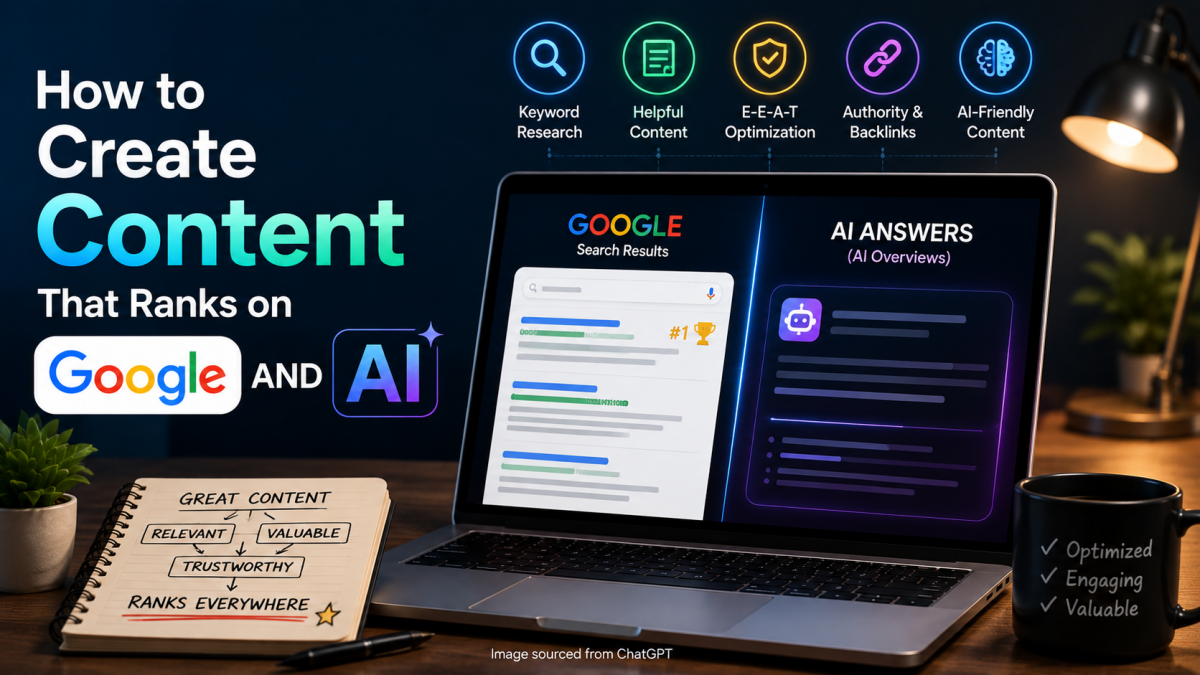
Search visibility is changing. Ranking on the first page of Google is still important. Still, your content may now be discovered through Google AI Overviews, ChatGPT Search, Gemini, Perplexity, Microsoft Copilot, and other AI-powered search experiences.
This means businesses need to think beyond traditional keyword optimisation.
Creating effective content for AI SEO means producing useful, trustworthy, well-structured information that can perform in traditional search while also being easy for AI systems to understand, retrieve, summarise, and reference.
The good news is that you don’t need two separate content strategies. Many of the principles that make content valuable for Google also make it useful for AI search.
Here’s how to create content that can perform across both.
What Is Content for AI SEO?
Content for AI SEO is content designed to perform in traditional search engines while also being structured, authoritative, and useful enough to appear in AI-generated search experiences.
It combines established SEO practices with Answer Engine Optimization (AEO) and Generative Engine Optimization (GEO).
Instead of asking only:
“How can we rank #1 for this keyword?”
Businesses should also ask:
“How can our content become a trusted answer or source when someone asks an AI platform about this topic?”
This changes the focus from simply placing keywords on a page to providing clear answers, comprehensive topical coverage, evidence, expertise, and original value.
Why Content Strategy Is Changing
Traditional search often followed a simple journey:
Search query → Search results → Website → Answer
AI-powered search can create a different journey:
Question → AI-generated response → Sources/recommendations → Website
Google’s AI experiences can synthesize information and provide links for users who want to explore further. Chat-GPT Search can similarly search the web and provide answers with links to sources.
As a result, a page may create value even when the user doesn’t immediately click it.
Modern SEO therefore needs to consider three forms of visibility:
| Strategy | Main Objective |
|---|---|
| SEO | Rank prominently in organic search |
| AEO | Become a clear answer to a user’s question |
| GEO | Increase visibility in generative AI experiences |
The strongest content strategy combines all three.
1. Start With Search Intent, Not Just Keywords
One of the biggest mistakes in SEO content creation is starting with a keyword and writing everything possible around it.
Instead, understand why someone searches for that keyword.
Search intent generally falls into four categories:
- Informational
- Commercial investigation
- Transactional
- Navigational
For example, someone searching:
“What is AI SEO?”
probably wants an explanation.
Someone searching:
“best AI SEO agency”
is likely comparing providers.
Your page should match the user’s actual objective.
For AI search, go one step further and identify the questions users might naturally ask conversationally.
For example:
Keyword: AI SEO
Conversational searches:
- How does AI SEO work?
- Is AI SEO different from traditional SEO?
- How can I optimize my website for AI search?
- Can AI SEO help my business appear in ChatGPT?
- What is the difference between AEO and GEO?
This creates content that serves both keyword searches and conversational queries.
2. Give the Answer Early
AI-friendly content shouldn’t make users read 500 words before receiving an answer.
If your heading asks:
What Is Generative Engine Optimization?
Follow it immediately with a concise definition.
For example:
Generative Engine Optimization (GEO) is the process of improving content and digital authority so a brand or website can gain greater visibility in AI-generated search experiences.
You can then expand on the definition.
This answer-first structure works particularly well for:
- Definitions
- How-to questions
- FAQs
- Comparisons
- Benefits
- Pros and cons
- Troubleshooting queries
It also makes the page easier for busy users to scan.
3. Build Topical Depth Instead of Repeating Keywords
Traditional SEO was sometimes associated with repeating an exact keyword multiple times.
Modern content needs much greater contextual depth.
If you’re writing about AI SEO, related concepts could naturally include:
Google AI Overviews, AEO, GEO, ChatGPT Search, entity optimization, semantic SEO, structured data, search intent, topical authority, crawling, indexing, citations, content quality, EEAT, and conversational search.
These concepts help establish what the page is really about.
Don’t force them into the copy. Include them only where they help explain the topic.
The objective is semantic completeness, not keyword density.
4. Structure Content So Humans and Machines Can Understand It
Clear structure benefits readers, Google, and AI systems.
Use a logical hierarchy:
H1 → H2 → H3
Each section should address a specific question or subtopic.
A strong article might include:
- A concise introduction
- Quick definition
- Why the topic matters
- Step-by-step process
- Examples
- Comparison table
- Common mistakes
- Best practices
- FAQs
- Next action
Avoid unnecessarily long paragraphs and vague headings such as “Things You Need to Know.”
Instead, use descriptive headings such as:
How Do You Optimize Content for AI Search?
The reader and the search system immediately understands what the section covers.
5. Create Information Worth Citing
This is one of the most important differences between average SEO content and strong content for AI SEO.
AI can already generate generic explanations.
Your content needs something better.
Add information such as:
- Original research
- First-hand experience
- Expert commentary
- Case studies
- Unique processes
- Real examples
- Proprietary data
- Industry observations
- Tested strategies
For example, instead of saying:
“Internal linking is important for SEO.”
Explain how your team uses internal linking, what pages you prioritize, how you identify contextual opportunities, and what results you monitor.
That creates information gain something useful beyond what dozens of competing articles already say.
6. Strengthen EEAT Signals
Content shouldn’t merely sound authoritative. Readers should be able to understand why they can trust it.
Google’s EEAT framework focuses on:
Experience, Expertise, Authoritativeness, and Trustworthiness.
Strengthen these signals through:
- Clear author information
- Expert review where appropriate
- First-hand examples
- Accurate facts
- Reliable references
- Transparent business information
- Updated content
- Clear editorial standards
For business content, demonstrating genuine experience is particularly valuable.
Don’t simply explain what should theoretically work. Show that you understand how it works in practice.
7. Support Important Claims With Reliable Sources
If your article includes statistics, studies, algorithm information, or technical claims, link to credible original sources wherever possible.
Good sources may include:
- Google Search Central
- Official platform documentation
- Government websites
- Universities
- Original research
- Recognized industry organizations
Avoid adding statistics purely to make an article look authoritative.
A useful rule is:
If a number materially influences the reader’s conclusion, provide the source.
Accurate sourcing improves user trust and makes the article more useful as a reference.
8. Use Formats That Make Answers Easy to Extract
Not every answer should be buried inside paragraphs.
Choose the format that best matches the information.
Use tables for comparisons
| Content Element | Why It Helps |
|---|---|
| Clear definitions | Provides direct answers |
| Question-based headings | Matches conversational searches |
| Tables | Simplifies comparisons |
| Numbered steps | Explains processes clearly |
| Bullet lists | Makes key information scannable |
| FAQs | Addresses related questions |
| Original examples | Demonstrates experience |
These formats can also support Featured Snippets, AI Overviews, voice search, and conversational search experiences.
9. Optimize for Entities and Context
AI search increasingly requires understanding relationships between concepts, organizations, products, people, and places.
These are entities.
For example, an article about AI search optimization might naturally mention relevant entities such as:
Google, Google Search, Google AI Overviews, OpenAI, ChatGPT, Microsoft Bing, Gemini, and Perplexity.
Entity optimization does not mean inserting as many brand names as possible.
It means creating enough accurate context for search systems to understand:
- Who you are
- What you specialize in
- Which topics you’re associated with
- How different concepts on your website relate
This is also why strong internal linking and topic clusters matter.
10. Build Topic Clusters Around Your Expertise
One article rarely establishes topical authority.
Suppose your core service is AI-powered digital marketing.
You could build a cluster containing:
AI Digital Marketing
↓
AI SEO
↓
Google AI Overviews
↓
Answer Engine Optimization
↓
Generative Engine Optimization
↓
Chat-GPT Search Optimization
↓
AI Content Strategy
Each article should answer a distinct search intent and link naturally to relevant supporting pages.
Over time, this creates a connected knowledge ecosystem instead of a collection of unrelated blog posts.
11. Don’t Forget Technical SEO
Excellent content still needs to be accessible.
Before worrying about advanced GEO tactics, make sure your website has solid SEO foundations.
Check:
- Crawlability
- Indexability
- Mobile usability
- Page speed
- HTTPS
- Canonical tags
- XML sitemap
- Internal links
- Structured data
- Clear site architecture
Search and AI visibility depend on systems being able to access and understand your information.
Common AI SEO Content Mistakes
Avoid these mistakes when creating content for Google and AI:
Publishing Unedited AI Content
AI can accelerate research and drafting, but mass-publishing generic content adds little value.
Writing Only for Keywords
A page can contain the perfect keyword and still fail if it doesn’t satisfy the reader’s intent.
Creating Multiple Pages for Nearly Identical Keywords
This can create unnecessary duplication and keyword cannibalization. Build comprehensive pages around topics rather than tiny keyword variations.
Making Unsupported Claims
Don’t invent statistics, research, customer results, or “expert” quotes.
Ignoring Existing Content
Sometimes the best strategy isn’t another article. Updating an existing high-potential page can be more valuable.
A Practical Content for AI SEO Checklist
Before publishing, ask:
- Does the article completely satisfy search intent?
- Is the main question answered clearly near the beginning?
- Does the page provide information competitors don’t?
- Are important claims accurate and properly sourced?
- Are headings descriptive and logically structured?
- Are relevant entities and related concepts covered naturally?
- Does the article demonstrate real expertise or experience?
- Are tables, lists, and FAQs used where useful?
- Does the page link to relevant supporting content?
- Is the page technically crawlable and indexable?
- Would a human genuinely find this the best answer to their question?
If the answer to most of these is yes, you’re creating content for search visibility, not merely content containing keywords.
Frequently Asked Questions
Can the same content rank on Google and appear in AI search?
Yes. Strong SEO fundamentals useful content, clear structure, technical accessibility, authority, and accurate information also provide a strong foundation for visibility in AI-powered search experiences.
How do I optimize content for Google AI Overviews?
Answer questions clearly, satisfy search intent, provide comprehensive and trustworthy information, use strong SEO fundamentals, and ensure important pages are accessible to Google.
How do I create content for ChatGPT Search?
Focus on publishing accessible, authoritative, original web content that answers real questions clearly. Avoid trying to write specifically for an AI model at the expense of human readers.
What is the difference between SEO and GEO?
SEO aims to improve organic search visibility. GEO focuses on increasing a brand or content’s visibility within generative AI answers and experiences. They should work together rather than operate as separate strategies.
Is AI-generated content bad for SEO?
Not automatically. The bigger issue is quality. Content should provide original value, accuracy, expertise, and a strong user experience regardless of whether AI assisted in its creation.
Final Thoughts
Creating content for AI SEO doesn’t require abandoning everything that works in traditional SEO.
The fundamentals remain essential: understand search intent, provide genuinely useful information, demonstrate expertise, maintain strong technical SEO, and create a trustworthy website.
What’s changing is the number of places where that content can be discovered.
Your next customer may find your business through a Google organic result, an AI Overview, Chat-GPT Search, Gemini, Perplexity, or another AI-powered experience.
The goal, therefore, shouldn’t be to write for AI.
It should be to create the clearest, most useful, trustworthy, and authoritative resource on the topic and make sure both search engines and AI systems can understand it.
Want Your Content to Perform Across Google and AI Search?
Velocity Consultancy helps businesses develop SEO and AI-search strategies built around SEO, AEO, GEO, topical authority, and high-quality content. If your existing content is ranking inconsistently or you’re unsure whether your website is ready for AI-powered search book a free AI SEO consultation with Velocity Consultancy to identify your biggest content and visibility opportunities.


