

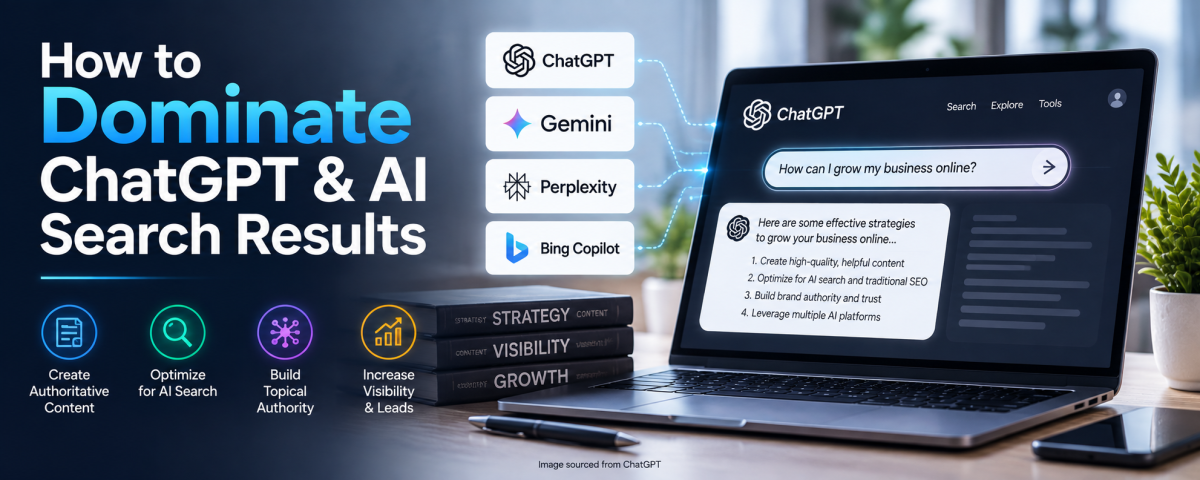
Search is expanding beyond traditional Google results. Business owners and marketing managers are increasingly considering how their brands can be discovered through ChatGPT Search, Google AI Overviews, Gemini, Perplexity, Microsoft Copilot, and other AI-powered search experiences.
This creates an important commercial question: How do you rank in ChatGPT search and other AI results?
There is no guaranteed formula or special markup that automatically earns a ChatGPT citation. However, businesses can improve their chances of being discovered by combining strong SEO foundations with technically accessible websites, authoritative content, clear brand signals, and Generative Engine Optimization (GEO).
This guide explains how.
What Does It Mean to Rank in ChatGPT Search?
Ranking in ChatGPT search means having your website, content, products, services, or brand surfaced as a relevant source when ChatGPT searches the web to answer a user’s question.
Unlike Google, where marketers often track a specific organic position, AI search visibility can include:
- Website citations
- Links within generated answers
- Brand mentions
- Product or service recommendations
- Referral visits from AI platforms
This means businesses should look beyond a single ranking position and consider whether their brand is discoverable, relevant, and trusted during AI-assisted research.
What Is Generative Engine Optimization (GEO)?
Generative Engine Optimization (GEO) is the process of improving your content and digital presence to increase visibility within AI-generated search experiences.
GEO doesn’t replace traditional SEO. It extends it.
Traditional SEO helps search engines discover, understand, and rank your pages. GEO focuses on making your information useful and authoritative enough to be referenced within generative answers.
For businesses, the practical strategy is straightforward:
SEO + AEO + GEO = Broader Search Visibility
Rather than treating each as a separate marketing channel, build one strong search strategy that works across traditional and AI-powered discovery.
How Does ChatGPT Search Find Website Content?
Before improving content, make sure your website is technically available for discovery.
OpenAI states that public websites can potentially appear in ChatGPT search. Publishers that want their content discoverable should ensure OAI-SearchBot isn’t blocked from accessing relevant pages.
Check that:
- Important pages are publicly accessible.
- Your robots.txt isn’t unintentionally blocking OAI-SearchBot.
- Your hosting or CDN isn’t blocking relevant crawlers.
- Pages return the correct HTTP status codes.
- Canonical URLs are properly configured.
- Important pages aren’t accidentally marked
noindex.
Technical accessibility doesn’t guarantee a citation. It simply ensures your website is eligible to be discovered.
1. Create Content Around Real Customer Questions
AI search is highly conversational.
A potential customer might ask:
“Which SEO agency is best for a small business in Mumbai?”
instead of simply searching:
“SEO agency Mumbai.”
Your content should therefore address the questions surrounding your products, services, and expertise.
Cover topics such as:
- What is the service?
- How does it work?
- Who needs it?
- What does it cost?
- What problems does it solve?
- How does it compare with alternatives?
- How should someone choose a provider?
- What mistakes should buyers avoid?
This creates deeper topical coverage while naturally targeting both traditional and conversational searches.
2. Give Clear Answers Before Detailed Explanations
Don’t make users read several paragraphs before reaching the answer.
For example:
What Is AI SEO?
Start with a concise definition:
AI SEO combines artificial intelligence with SEO strategies to improve research, content optimization, analysis, and visibility across traditional and AI-powered search.
Then provide the deeper explanation.
This answer-first format works particularly well for:
- Definitions
- Comparisons
- How-to questions
- Benefits
- FAQs
- Troubleshooting searches
It also makes content easier for users to scan and understand.
3. Publish Information AI Cannot Easily Reproduce
Generic information is increasingly easy to generate.
If your article simply repeats what dozens of competitors already say, there is little reason for users or an AI search system to prefer it.
Create non-commodity content such as:
- Original case studies
- First-hand experience
- Proprietary research
- Expert commentary
- Real campaign examples
- Customer questions
- Original frameworks
- Industry-specific observations
- Experiments and findings
For example, instead of writing:
“SEO helps businesses increase traffic.”
Show what your team changed, why you changed it, what happened, and what you learned.
Original information creates stronger differentiation and demonstrates genuine expertise.
4. Build Topical Authority Around Your Services
Avoid publishing disconnected blogs simply because individual keywords have search volume.
Build interconnected topic clusters around your core expertise.
For an AI digital marketing company, this could include:
AI Digital Marketing
→ AI SEO
→ Generative Engine Optimization
→ Answer Engine Optimization
→ Google AI Overviews
→ ChatGPT Search
→ Perplexity SEO
→ AI Content Strategy
→ Semantic SEO
Each article should answer a distinct search intent and link naturally to relevant service and supporting pages.
This creates a connected knowledge ecosystem instead of a collection of isolated posts.
5. Strengthen Your Brand and Entity Signals
AI visibility isn’t only about individual articles. Search systems also need clear information about who your business is and what it does.
Keep important information consistent across your website:
- Business name
- Core services
- Areas of expertise
- Location
- Team members
- Authors
- Contact details
- Relevant profiles
Create strong About, Contact, Service, and Author pages.
Use relevant structured data where appropriate, but ensure it accurately represents information visible to users.
The objective is to establish a clear and verifiable digital identity around your areas of expertise.
6. Demonstrate Real Experience and Expertise
AI can generate generic explanations quickly. Your competitive advantage is what AI doesn’t inherently possess: your company’s experience.
Strengthen your content with:
- Named expert authors
- First-hand observations
- Original examples
- Real case studies
- Client outcomes where permission exists
- Accurate references
- Transparent company information
- Regular content updates
This also supports Google’s EEAT principles: Experience, Expertise, Authoritativeness, and Trustworthiness.
For commercial queries, these signals are particularly important because potential customers aren’t only looking for information—they’re deciding whom to trust.
7. Make Important Pages Worth Referencing
Before publishing, ask:
Why would someone reference this page instead of the competing pages?
Give them a reason.
Add:
Original Data: Publish findings from your own campaigns, surveys, or research.
Expert Insights: Share observations based on actual experience.
Useful Comparisons: Make complex buying decisions easier.
Clear Definitions: Explain technical concepts accurately.
Primary Sources: Support important factual claims with reliable documentation.
Real Examples: Demonstrate how strategies work in practice.
Fresh Information: Regularly review fast-changing AI and search topics.
The goal isn’t simply to produce more content. It is to produce information worth using as a source.
8. Target Commercial AI Search Queries
If your goal is lead generation, don’t optimize only for educational questions.
Build content across the buyer journey.
| Funnel Stage | Example Query |
|---|---|
| Informational | What is GEO? |
| Problem-aware | Why isn’t my website appearing in ChatGPT? |
| Comparison | GEO vs SEO: what’s the difference? |
| Commercial | Best GEO agency for B2B companies |
| Transactional | GEO services in Mumbai |
This allows topical authority content to support commercial pages rather than generating traffic with no clear path to conversion.
9. Keep Traditional SEO Strong
AI search doesn’t make established SEO fundamentals irrelevant.
Continue investing in:
- Keyword and search-intent research
- Technical SEO
- Crawlability
- Indexation
- Internal linking
- Helpful content
- Page experience
- Relevant backlinks
- Digital PR
- Structured data
- Image and video optimization
Think of GEO as an additional visibility layer built on a strong SEO foundation—not a shortcut around SEO.
10. Measure AI Search Visibility
Traditional rank tracking alone doesn’t show your full search presence.
Businesses should gradually add AI-specific measurements such as:
AI Referrals
Track visitors arriving from platforms such as ChatGPT and other AI discovery tools.
AI Citations
Monitor whether important pages and your brand appear as sources for relevant industry questions.
Branded Visibility
Track changes in branded searches and mentions as your authority grows.
Conversions
Most importantly, determine whether AI-driven visitors become:
- Leads
- Calls
- Consultation requests
- Email enquiries
- Customers
Visibility is useful, but commercial impact should remain the ultimate measurement.
Common GEO Mistakes Businesses Should Avoid
Avoid turning GEO into another checklist of supposed ranking tricks.
Common mistakes include:
- Mass-producing generic AI articles
- Creating hundreds of near-duplicate question pages
- Keyword stuffing
- Fabricating statistics or expert quotes
- Ignoring technical SEO
- Buying fake brand mentions
- Assuming schema guarantees AI citations
- Optimizing only for ChatGPT
- Measuring mentions without measuring leads
A sustainable strategy focuses on quality, accessibility, authority, relevance, and genuine expertise.
GEO Strategy Checklist
Before investing heavily in AI search optimization, make sure your business has:
- A technically crawlable website
- Access for relevant search crawlers
- Strong traditional SEO foundations
- Clear business and service information
- Comprehensive topic clusters
- Direct answers to customer questions
- First-hand expertise
- Original, reference-worthy information
- Strong internal linking
- Accurate structured data where relevant
- Clear trust signals
- AI referral and conversion tracking
These foundations give your business a stronger chance of being discovered across both traditional and AI-powered search.
FAQs
Can I rank my website in ChatGPT search?
Your website can potentially appear as a source in ChatGPT search if its public content is accessible and relevant. However, there is no guaranteed position or inclusion.
How can I increase my chances of appearing in ChatGPT?
Start with technical accessibility, then build authoritative topic coverage, answer relevant questions clearly, demonstrate genuine expertise, strengthen your brand presence, and publish original information worth referencing.
Does ChatGPT have rankings like Google?
Not in the traditional sense of a fixed first-to-tenth organic results page. Visibility can instead occur through sources, links, mentions, and recommendations within AI-generated responses.
Is GEO replacing SEO?
No. GEO expands SEO into generative search environments. Strong SEO remains essential for crawlability, authority, content quality, and overall search visibility.
How long does GEO take to work?
There is no guaranteed timeline. Results depend on your existing authority, technical accessibility, competition, content quality, relevance, and the queries AI search systems encounter.
Can schema markup make my business appear in ChatGPT?
Schema can help search engines understand structured information, but it doesn’t guarantee ChatGPT citations or AI visibility.
Build Visibility Beyond Traditional Google Rankings
If you want to rank in ChatGPT search, don’t look for a single GEO trick.
Build a website that deserves to be discovered: technically accessible, authoritative, useful, well-connected, and backed by genuine expertise.
As customers increasingly research businesses through Google, ChatGPT, Gemini, Perplexity, and other AI-powered platforms, your search strategy needs to cover the entire discovery ecosystem.
Velocity Consultancy helps businesses combine SEO, AI SEO, AEO, and GEO to improve visibility across traditional and AI-powered search.
If you want to identify where your business is currently visible and where competitors may be gaining an advantage book a free AI SEO & GEO consultation.


 15+ Years Of Expertise
 100% Confidential