

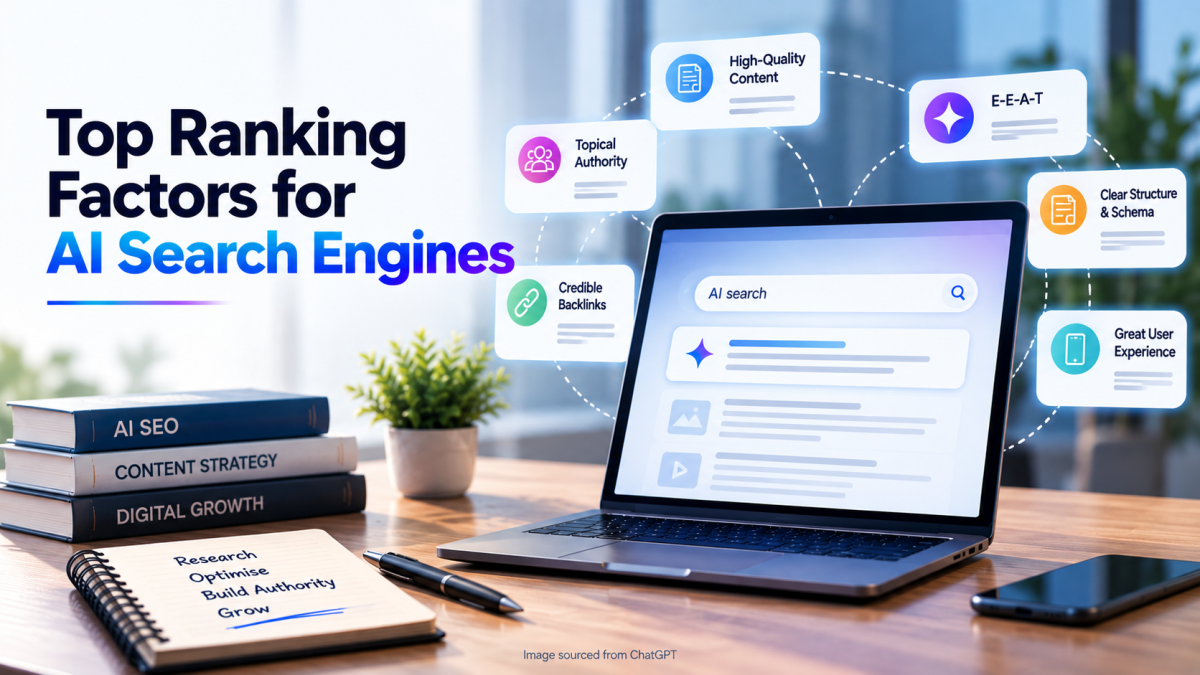
Key Takeaways
- There is no single universal list of AI ranking factors used by Google AI Overviews, ChatGPT Search, Bing Copilot, Perplexity, and other AI search systems.
- Strong SEO fundamentals still matter: crawlability, indexability, relevance, content quality, internal linking, and technical accessibility create the foundation for AI-search visibility.
- Clear answers, subject-matter depth, supporting evidence, accurate information, and strong entity context can make content easier for AI systems to retrieve and reference.
- Technical accessibility matters. For example, OpenAI states that sites must allow OAI-SearchBot to be eligible for inclusion in ChatGPT search answers.
- Businesses should measure AI citations and visibility alongside traditional rankings, organic traffic, leads, and conversions.
What Are AI Ranking Factors?
AI ranking factors are the signals and characteristics that can influence whether content is discovered, retrieved, selected, cited, or surfaced by AI-powered search experiences.
However, AI search does not operate through one universal ranking algorithm.
Google AI Overviews, Google AI Mode, ChatGPT Search, Microsoft Copilot, Bing, and other AI-powered discovery systems have different technologies and retrieval processes.
Therefore, businesses should be cautious about articles claiming to have discovered a definitive list of AI ranking factors.
A more practical approach is to focus on the factors that make content discoverable, relevant, trustworthy, understandable, current, and useful across search experiences.
How Are AI Search Engines Different From Traditional Search Engines?
Traditional search commonly presents users with ranked webpages. AI-powered search can additionally retrieve information from multiple sources and synthesize it into a direct response.
That changes what search visibility can look like.
| Traditional Search | AI-Powered Search |
|---|---|
| Frequently presents ranked webpage listings | Can generate synthesized answers using retrieved information |
| Visibility is commonly measured through rankings, impressions and clicks | Visibility may also include citations, references and inclusion in generated answers |
| Users often visit websites to find the complete answer | Users may receive substantial information directly within the search experience |
| Optimization frequently starts at page and keyword level | AI-search strategies also emphasize entities, questions, context and information retrieval |
This does not mean traditional SEO has become irrelevant.
Instead, strong SEO provides much of the technical and content foundation needed for visibility in AI-powered search.
What Are the Most Important AI Ranking Factors?
No responsible SEO strategy should promise that optimizing a checklist will guarantee AI citations.
However, current guidance from major search platforms reveals several areas businesses should prioritize.
1. Crawlability and Indexability
Before an AI-powered search system can use your website as a source, it generally needs a way to discover and access the content.
Technical barriers can limit that visibility.
Important considerations include:
- Robots.txt configuration
- Indexing directives
- XML sitemaps
- Internal links
- Server accessibility
- HTTP status codes
- JavaScript rendering
For ChatGPT specifically, OpenAI says websites should allow OAI-SearchBot if they want their content to be eligible for inclusion in ChatGPT search results. OpenAI distinguishes OAI-SearchBot, which supports search, from GPTBot, which relates to model training.
Practical takeaway: AI SEO starts with making sure the platforms you want visibility from can actually access your content.
2. Search Intent and Relevance
A page should clearly satisfy the question or problem behind the search.
Instead of building pages around exact-match keywords alone, determine:
- What is the user asking?
- What information do they need?
- What follow-up questions are likely?
- What entities are involved?
- What level of detail does the query require?
For example, someone searching “What is AI SEO?” probably needs a definition and explanation.
Someone searching “best AI SEO agency” is likely evaluating service providers.
Those queries require different content.
Matching the user’s underlying intent is more useful than repeating the target keyword throughout a page.
3. Content Quality and Original Value
AI-search optimization should not mean producing more generic AI-generated articles.
Useful content should contribute meaningful information.
This can include:
- Original explanations
- Expert commentary
- First-hand experience
- Original research
- Real examples
- Unique data
- Detailed processes
- Case studies
A page that simply rewrites information already available across hundreds of websites provides little additional value.
For businesses, the objective should be to publish content worth referencing.
4. Clear and Extractable Answers
AI systems need to identify information that directly addresses a user’s question.
That makes content structure important.
A useful format is:
Question → Direct Answer → Explanation → Evidence → Example
For example:
What is Generative Engine Optimization?
Generative Engine Optimization (GEO) is the practice of improving how content can participate in AI-generated search and answer experiences through clear, authoritative, discoverable, and context-rich information.
The article can then expand on the definition.
Clear headings, concise definitions, lists, tables, and supporting details can make important information easier to understand and reference.
Microsoft’s Bing team specifically recommends improving clarity and structure on pages, including headings, tables, and FAQ sections, while also strengthening depth and supporting claims with evidence when improving content for AI-generated answers.
5. Topical Depth and Expertise
A single article cannot always establish meaningful expertise around a complex subject.
Businesses should build interconnected resources covering relevant subtopics.
For an AI SEO content cluster, this could include:
- AI search optimization
- Google AI Overviews
- ChatGPT Search
- AI ranking factors
- Generative Engine Optimization
- Answer Engine Optimization
- Topical authority
- AI content strategy
- Entity SEO
- AI-search measurement
The objective is not to publish dozens of articles merely to increase page count.
Each page should address a distinct question or search intent while contributing to a broader area of expertise.
Microsoft’s AI Performance guidance notes that pages cited for particular grounding queries can reflect clear subject focus and domain expertise, and recommends strengthening related coverage where appropriate.
6. Evidence and Trust
Claims are more useful when readers can verify them.
Where appropriate, content should reference:
- Official documentation
- Original research
- Government sources
- Academic research
- First-party datasets
- Documented case studies
Microsoft recommends supporting claims with examples, data, and cited sources when creating content that may be reused in AI-generated answers.
Avoid inventing statistics simply to make an article appear authoritative.
Verifiable information is more valuable than unsupported confidence.
7. Entity Clarity and Context
Modern search systems need to understand what a page is discussing and how different concepts relate.
Entities can include:
- People
- Organizations
- Products
- Services
- Locations
- Technologies
- Platforms
- Industry concepts
For example, an article about AI search marketing could establish clear relationships between:
Google → AI Overviews → Google Search → AI-generated answers → SEO → business visibility.
Use full names and descriptive language where appropriate rather than relying heavily on vague references.
8. Content Freshness and Accuracy
Freshness becomes particularly important when information changes frequently.
AI search, software, technology, finance, laws, product specifications, and statistics can become outdated quickly.
Microsoft says its AI Performance tools can help publishers identify pages used in AI-generated answers and recommends keeping cited content fresh and accurate.
For important content:
- Review outdated statistics
- Update screenshots
- Check external references
- Remove obsolete recommendations
- Update platform terminology
- Review internal links
- Add meaningful new information
Do not change publication dates without genuinely updating the content.
9. Internal Linking and Content Relationships
Internal links help connect related information across your website.
For example:
AI Search Optimization → AI Ranking Factors → Topical Authority → AI Content Strategy → ChatGPT Search Optimization
This creates a logical information architecture for both users and search systems.
Use descriptive anchor text and link only where the destination provides meaningful additional information.
10. Brand and Source Authority
Authority cannot be created simply by adding the word “expert” to an author biography.
Businesses should demonstrate why readers should trust them.
Potential authority signals include:
- Real subject-matter experts
- Documented professional experience
- Original research
- Accurate author information
- Transparent company information
- Independent mentions
- Relevant citations and backlinks
- Consistent expertise across related topics
The goal is to create a verifiable identity around the people and organization responsible for the information.
AI Ranking Factors vs Traditional SEO Ranking Factors
There is significant overlap between the two.
| Factor | Traditional SEO | AI Search |
|---|---|---|
| Crawlability | Important | Important for discoverability |
| Search intent | Important | Important |
| Content quality | Important | Important |
| Technical SEO | Important | Provides a discovery/access foundation |
| Clear answers | Useful for search results and snippets | Useful for retrieval and citation |
| Evidence | Supports credibility | Supports trustworthy, referenceable content |
| Freshness | Query-dependent | Especially relevant for changing information |
| Topical depth | Supports comprehensive coverage | Provides broader contextual coverage |
The key lesson is simple:
AI SEO is not a replacement for traditional SEO. It expands the way businesses think about discoverability, content structure, authority, and measurement.
Common AI SEO Mistakes
Chasing a Secret AI Ranking Formula
There is no verified universal formula for ranking across every AI search engine.
Focus on durable principles rather than speculative tricks.
Publishing Mass-Generated Content
Content volume alone does not create expertise.
Prioritize usefulness, originality, accuracy, and relevance.
Ignoring Technical Accessibility
Excellent content cannot contribute effectively to search experiences if relevant crawlers cannot access it.
Review indexing and crawler permissions.
Writing Only for AI Systems
The ultimate audience is still the person searching for information.
Content should be easy to read, genuinely useful, and written for humans.
Assuming AI Citations Are Guaranteed
No legitimate SEO strategy can guarantee inclusion in Google AI Overviews, ChatGPT Search, Copilot, or another generative answer.
Optimization improves the foundation for visibility; it does not guarantee selection.
How to Measure AI Search Visibility
AI-search measurement is improving quickly.
Businesses can monitor:
- AI citations
- Cited URLs
- AI referral traffic
- Queries associated with cited pages
- Topic-level visibility
- Organic impressions and clicks
- Brand mentions
- Qualified leads
- Conversions
Microsoft introduced AI Performance reporting in Bing Webmaster Tools in 2026, providing visibility into citations, cited URLs, and grounding queries across supported Microsoft AI experiences. It later expanded those insights with topics, intents, citation share, and comparison capabilities.
OpenAI also adds `utm_source=chatgpt.com` to ChatGPT search referral URLs, which can help publishers analyze inbound traffic from ChatGPT search.
Google, meanwhile, expanded Search Console reporting in September 2026 with additional reporting for generative AI and multimodal search experiences.
A Practical AI Ranking Factors Framework
Instead of trying to reverse-engineer every AI platform, businesses can use this framework:
- Discoverable: Can search and AI crawlers access the content?
- Relevant: Does the page satisfy the user’s actual intent?
- Clear: Can important answers be easily identified and understood?
- Comprehensive: Does the content provide enough context to answer the question properly?
- Credible: Are important claims supported by trustworthy evidence?
- Experienced: Does the content contain genuine expertise or original value?
- Connected: Does the website demonstrate meaningful relationships between related topics and entities?
- Current: Is information accurate and up to date?
- Measurable: Are you monitoring both traditional search performance and emerging AI-search visibility?
Think beyond “How do I rank in AI?” and ask: “Why would an AI search system or user consider this page a useful source for this question?”
The Future of AI Ranking Factors
AI search will continue to change, and measurement is already becoming more sophisticated.
Microsoft now reports citation activity, grounding queries, intents, topics, and citation share for supported AI experiences, while Google continues expanding Search Console reporting for newer search experiences.
The specific systems will evolve, but businesses can build a more durable foundation by focusing on accessible websites, useful content, strong subject expertise, accurate information, evidence, and clear answers.
Visit: Velocity Consultancy’s AI-powered digital marketing services to explore how SEO, content strategy, and AI search marketing can work together.
Frequently Asked Questions
What are AI ranking factors?
AI ranking factors are the signals and content characteristics that can affect whether information is discovered, retrieved, referenced, or surfaced by AI-powered search systems. There is no single universal set shared by every AI platform.
What is the most important ranking factor for AI search?
There is no verified single most important AI ranking factor. A strong strategy combines technical accessibility, relevance, useful content, clarity, credibility, topical expertise, and accurate information.
How do I rank in ChatGPT Search?
There is no guaranteed method for ranking in ChatGPT Search. OpenAI states that websites should allow OAI-SearchBot to be eligible for inclusion in ChatGPT search answers, while relevance and reliability also influence search results.
Do backlinks matter for AI search?
Links remain important to web discovery and traditional search authority, but there is no public universal rule stating that backlink quantity determines citation across all AI search engines. Focus on earning legitimate references rather than manipulating link counts.
Does schema markup improve AI rankings?
Structured data can help search engines understand eligible page information, but adding schema does not guarantee an AI citation or higher AI visibility. Schema should accurately represent content visible on the page.
Does content freshness matter for AI search?
Freshness can matter significantly when a query requires current information. Microsoft explicitly recommends keeping content fresh and accurate for AI-generated search experiences.
Can AI-generated content rank in AI search engines?
The method used to draft content is less useful as an optimization target than the quality of the finished page. Content should provide accurate, original, useful, well-supported information rather than mass-produced generic material.
How can businesses track AI-search citations?
Available methods include AI referral tracking, manual citation monitoring, analytics platforms, and first-party tools such as Bing Webmaster Tools’ AI Performance reporting. Measurement capabilities vary by platform.
Conclusion
The most important lesson about AI ranking factors is that businesses should not search for a secret checklist that guarantees citations.
AI-powered search systems differ, and their retrieval and ranking processes continue to evolve.
A more sustainable strategy is to make your website technically accessible, answer search intent clearly, build topical expertise, publish original and trustworthy information, support important claims with evidence, and keep your content current.
Traditional SEO remains the foundation, while AI SEO expands the focus toward retrieval, citations, entity relationships, direct answers, and visibility within generative search experiences.
Want to improve your visibility across traditional and AI-powered search?
Book a Free AI SEO Consultation with Velocity Consultancy to build an SEO and AI-search strategy focused on sustainable organic visibility.


