
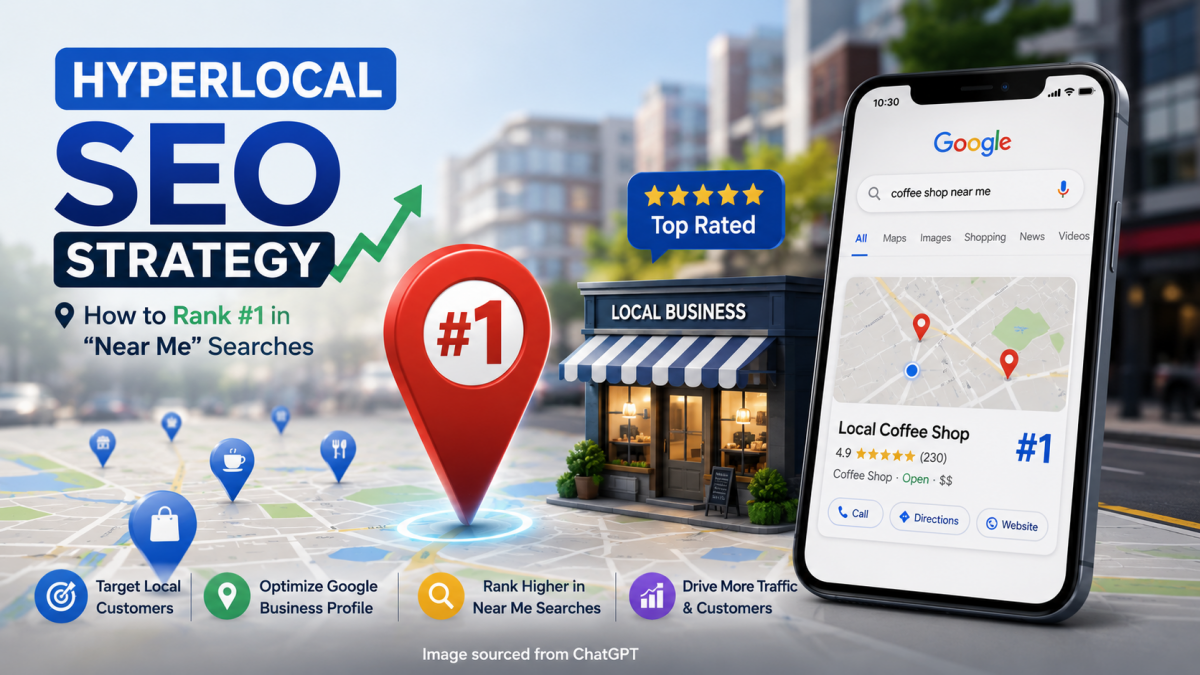
Quick Answer: To rank #1 in “near me” searches, optimize your Google Business Profile completely, build consistent NAP citations across local directories, earn location-specific backlinks and reviews, create hyperlocal content tied to neighborhoods you serve, and ensure your site sends strong proximity and relevance signals through schema markup and mobile-first performance. Google ranks “near me” results using three core factors: relevance, distance, and prominence.
“Near me” searches have changed how people find businesses. Someone doesn’t type “best dentist in Andheri West” anymore, they just type “dentist near me” and expect Google to know exactly where they are and what they need. If your business isn’t showing up in that moment, a competitor down the street is getting the customer instead.
Here’s how to actually win that spot.
How Google Ranks “Near Me” Searches
Google’s local algorithm weighs three factors when deciding who shows up for “near me” queries.
| Ranking Factor | What It Means | How to Improve It |
| Relevance | How well your business matches what the searcher wants | Optimize categories, services, and on-page content |
| Distance | How close your business is to the searcher | Can’t be changed, but multiple locations help |
| Prominence | How well-known and reputable your business is | Reviews, citations, backlinks, mentions |
Distance is mostly out of your control, but relevance and prominence are entirely within your hands, and that’s where hyperlocal SEO does the heavy lifting.
1. Optimize Your Google Business Profile Completely
Your Google Business Profile (GBP) is the single biggest ranking lever for “near me” searches. An incomplete or outdated profile is the fastest way to lose visibility.
What matters most:
Primary category set precisely (not just “Restaurant” but “Italian Restaurant” if that’s accurate)
Service area and business hours kept current, especially around holidays
Photos uploaded regularly, geo-tagged where possible
Posts published weekly using GBP’s update feature
Q&A section monitored and answered proactively
Businesses that update their GBP weekly tend to outperform competitors who set it up once and forget it. Google rewards activity because it signals the business is real and operating.
2. Build Consistent NAP Citations
NAP stands for Name, Address, Phone number. Every directory listing, business citation, and mention across the web needs to match exactly. Even small inconsistencies, like “St.” versus “Street,” can dilute trust signals.
- Priority citation sources:
- Google Business Profile
- Bing Places
- Apple Maps
- Industry-specific directories relevant to your niche
- Local chamber of commerce or business association listings
Audit existing citations before adding new ones. Cleaning up duplicates and incorrect listings usually moves the needle faster than building new ones from scratch.
3. Create Hyperlocal Content
Generic service pages don’t compete well in “near me” results. Content tied to specific neighborhoods, landmarks, or local events signals relevance that Google’s algorithm can actually use.
Effective formats include:
Location-specific landing pages for each area served (not duplicated content, genuinely unique copy)
Blog posts answering local questions (“best time to visit X neighborhood for Y service”)
Case studies or testimonials referencing specific local clients or projects
Local event coverage or community involvement posts
4. Earn Reviews and Respond to Every One
Review volume, recency, and response rate all factor into prominence. A business with 50 recent reviews and active responses will typically outrank one with 200 reviews from three years ago and no replies.
A simple system: ask every satisfied customer for a review at the point of service completion, respond to all reviews (positive and negative) within 48 hours, and never use fake or incentivized reviews, Google penalizes this aggressively when detected.
5. Add Local Business Schema Markup
Schema markup helps search engines (and AI Overview systems) understand your business data with certainty rather than inference. For “near me” searches specifically, LocalBusiness schema with embedded address, hours, geo-coordinates, and service area data gives Google cleaner signals to match against a searcher’s location.
This same structured data is increasingly what AI Overviews pull from when answering location-based questions directly in search results, making schema markup as important for AEO as it is for traditional SEO.
6. Build Local Backlinks
Backlinks from other local businesses, news sites, and community organizations carry more weight for hyperlocal rankings than generic national links. Sponsoring a local event, partnering with nearby complementary businesses, or getting featured in local news all build the kind of prominence signal Google trusts.
Why “Near Me” SEO Is Different From Traditional SEO
Traditional SEO optimizes for keywords and authority at a broad level. Hyperlocal SEO optimizes for a moment, a person standing somewhere, needing something nearby, right now. That shift means mobile speed, accurate location data, and real-time signals (like current hours or live availability) matter far more than they do for general organic rankings.
Frequently Asked Questions
How long does it take to rank in “near me” searches?
Most businesses see measurable movement within 60 to 90 days of consistent optimization, though competitive markets can take longer.
Does having multiple locations help with “near me” rankings?
Yes. Each verified location with its own optimized Google Business Profile increases the chance of appearing for searches across a wider geographic area.
Is Google Business Profile more important than my website for local rankings?
For “near me” searches specifically, yes. GBP is the primary data source Google uses, though a strong website still supports relevance and trust signals.
Can I rank in “near me” searches without a physical address?
It’s significantly harder. Service-area businesses can still rank using a defined service radius in GBP, but businesses with a verified physical location generally have an advantage.
Reviewed for accuracy by [Author Name], SEO Strategist with experience in local and hyperlocal search optimization across multiple industries.
Ready to dominate “near me” searches in your area? Velocity Consultancy is a Google Certified Partner with 15+ years of experience helping businesses rank higher in Google Maps and local search through Google Business Profile optimization and hyperlocal SEO strategy. Get in touch with Velocity Consultancy for a free local SEO audit tailored to your business.


 15+ Years Of Expertise
 100% Confidential