
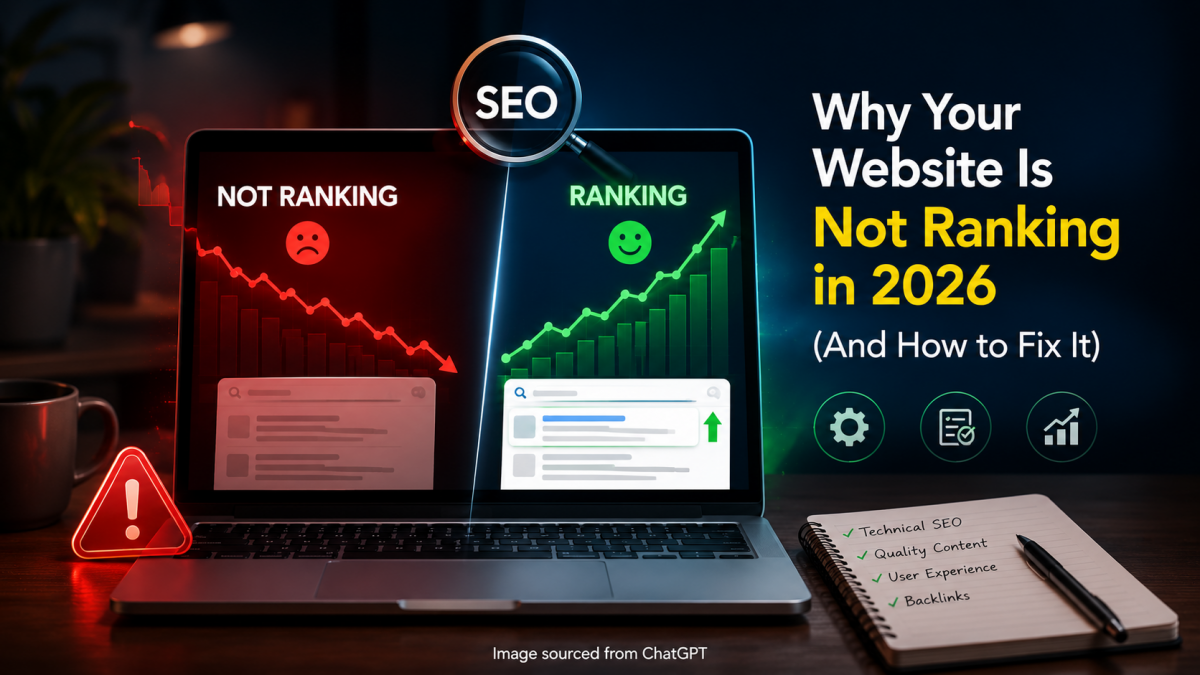
You’ve invested in a professional website, published content regularly, and even optimized a few keywords but your website still isn’t ranking on Google. If this sounds familiar, you’re not alone.
SEO has evolved significantly in 2026. Search engines now prioritize user experience, topical authority, helpful content, technical performance, and AI-powered search signals more than ever before. Simply adding keywords or publishing blog posts is no longer enough.
If your website isn’t appearing on the first page of search results, there’s usually a combination of technical, content, and authority issues holding it back.
In this guide, we’ll explore the most common reasons why websites fail to rank in 2026 and, more importantly, how you can fix them to improve your organic visibility.
Why Is My Website Not Ranking?
A website may struggle to rank because of poor technical SEO, weak content, lack of backlinks, slow loading speeds, poor user experience, or increased competition. Google’s ranking systems evaluate hundreds of factors, and improving just one area is rarely enough. A comprehensive SEO strategy delivers the best long-term results.
Common Reasons Your Website Isn’t Ranking
1. Your Website Isn’t Properly Indexed
If Google hasn’t indexed your pages, they won’t appear in search results regardless of how good your content is.
How to Check
Search:
site:yourdomain.com
If important pages don’t appear, Google may not have indexed them
How to Fix It
- Submit your XML sitemap through Google Search Console.
- Check your robots.txt file.
- Remove accidental “noindex” tags.
- Request indexing for new pages.
- Ensure important pages are internally linked.
2. You’re Targeting the Wrong Keywords
Many businesses either target keywords that are too competitive or use terms their audience isn’t actually searching for.
Instead of targeting broad keywords like:
- SEO
- Marketing
- Website Design
Focus on search intent-driven keywords such as:
- SEO company in Mumbai
- Best digital marketing agency for startups
- Local SEO services near me
- Ecommerce SEO agency
How to Fix It
- Conduct keyword research.
- Focus on long-tail keywords.
- Target informational and commercial intent.
- Analyze competitor keyword gaps.
3. Your Content Doesn’t Match Search Intent
Google wants to provide users with the most relevant answer.
For example, someone searching:
“Why is my website not ranking?”
expects solutions—not a sales pitch.
How to Fix It
- Answer user questions directly.
- Write comprehensive content.
- Add examples and practical tips.
- Structure content with clear headings.
- Update outdated articles regularly.
4. Your Website Lacks Topical Authority
Publishing random blog posts doesn’t establish expertise.
Google rewards websites that consistently cover a subject in depth.
For example, if you’re a digital marketing agency, your content should include topics like:
- SEO
- Local SEO
- Google Ads
- Meta Ads
- Content Marketing
- Technical SEO
- Website Optimization
- AI Search Optimization
How to Fix It
Build topic clusters that connect related articles using internal links.
5. Poor Technical SEO
Technical issues can prevent search engines from crawling and understanding your website.
Common problems include:
- Broken links
- Duplicate content
- Missing canonical tags
- Redirect chains
- Crawl errors
- Incorrect schema markup
How to Fix It
Perform regular technical SEO audits and resolve crawl, indexing, and performance issues promptly.
6. Slow Website Speed
Page speed remains an important ranking factor because it directly affects user experience.
Slow-loading websites often have higher bounce rates and lower engagement.
How to Improve Speed
- Compress images.
- Enable browser caching.
- Use a Content Delivery Network (CDN).
- Minify CSS and JavaScript.
- Choose reliable hosting.
- Optimize Core Web Vitals.
7. Poor Mobile Experience
Google uses mobile-first indexing, meaning it primarily evaluates the mobile version of your website.
If your site isn’t responsive, rankings can suffer.
Best Practices
- Responsive design
- Fast mobile loading
- Easy navigation
- Readable fonts
- Clickable buttons
- Proper spacing
8. Weak Internal Linking
Internal links help Google understand your site’s structure and distribute authority between pages.
Without them, valuable content may remain difficult to discover.
How to Fix It
- Link related blog posts.
- Connect service pages.
- Use descriptive anchor text.
- Create topic clusters.
9. You Don’t Have Enough High-Quality Backlinks
Backlinks remain one of Google’s strongest ranking signals.
However, quality matters much more than quantity.
Focus On
- Industry publications
- Guest blogging
- Digital PR
- Local citations
- Business directories
- Link-worthy content
Avoid buying spammy backlinks, as they can harm your rankings.
10. Your Website Lacks E-E-A-T Signals
Google evaluates:
- Experience
- Expertise
- Authoritativeness
- Trustworthiness
Websites that demonstrate genuine expertise and transparency are more likely to perform well.
Improve Trust By
- Adding author profiles
- Displaying business information
- Publishing case studies
- Including testimonials
- Keeping contact details updated
- Using HTTPS security
11. You’re Ignoring AI Search Optimization
In 2026, users increasingly discover content through AI-powered search experiences such as Google AI Overviews, ChatGPT, Gemini, and Perplexity.
These platforms favor content that is:
- Well-structured
- Factually accurate
- Easy to understand
- Comprehensive
- Helpful
- Clearly organized
How to Optimize
- Answer questions directly.
- Use descriptive headings.
- Add comparison tables.
- Include FAQs.
- Keep information up to date.
- Use schema markup where appropriate.
12. You’re Expecting Results Too Quickly
SEO is a long-term investment.
Depending on your competition and industry, meaningful improvements often take several months of consistent optimization.
The key is consistency not shortcuts.
How to Improve Your Website Rankings
A successful SEO strategy combines multiple elements rather than relying on a single tactic.
Focus on:
- Publishing high-quality, helpful content
- Improving technical SEO
- Building topical authority
- Earning authoritative backlinks
- Optimizing page speed
- Enhancing mobile usability
- Strengthening internal linking
- Tracking performance in Google Search Console
- Regularly updating existing content
Common SEO Mistakes to Avoid
- Keyword stuffing
- Publishing thin content
- Ignoring technical SEO
- Buying low-quality backlinks
- Neglecting mobile optimization
- Forgetting internal links
- Not tracking SEO performance
- Copying competitor content
- Ignoring user search intent
Avoiding these mistakes can significantly improve your chances of achieving sustainable rankings.
Frequently Asked Questions
Why is my website not ranking on Google?
Your website may not be ranking due to indexing issues, poor technical SEO, weak content, lack of backlinks, slow performance, or targeting the wrong keywords.
How long does SEO take in 2026?
Most websites begin seeing measurable improvements within three to six months, depending on competition, website quality, and the consistency of optimization efforts.
Can a new website rank quickly?
Yes, especially when targeting low-competition keywords, publishing high-quality content, and following SEO best practices from the start.
Do backlinks still matter in 2026?
Absolutely. High-quality backlinks continue to be one of Google’s strongest ranking signals, but relevance and authority are far more important than quantity.
Does AI affect SEO?
Yes. AI-powered search experiences are changing how users discover content. Websites with clear, trustworthy, and well-structured information are more likely to appear in AI-generated answers.
Final Thoughts
If your website isn’t ranking in 2026, it’s important to remember that SEO success isn’t determined by a single factor. Strong rankings result from a combination of high-quality content, technical optimization, authoritative backlinks, excellent user experience, and a clear understanding of search intent.
Instead of chasing quick fixes or outdated tactics, focus on building a website that genuinely helps users and demonstrates expertise in your industry. Over time, this approach leads to sustainable organic growth and stronger visibility across both traditional search engines and AI-powered search platforms.
Improve Your Rankings with Velocity Consultancy
At Velocity Consultancy, we help businesses improve their online visibility through comprehensive SEO strategies tailored to today’s search landscape. From technical SEO audits and keyword research to content optimization, local SEO, and AI search optimization, our experts create data-driven strategies designed to increase rankings, organic traffic, and qualified leads.
If your website isn’t generating the results you expect, contact Velocity Consultancy today and let our SEO specialists identify what’s holding your website back and build a strategy for long-term growth.


 15+ Years Of Expertise
 100% Confidential