

A nearby customer may no longer search only for “salon near me” or “plumber in Mumbai.” They might ask an AI search tool for a salon that handles curly hair, opens on Sunday and is easy to reach, or for a plumber who serves their neighbourhood and explains call-out charges clearly.
For local businesses, this creates a practical challenge: your online information needs to explain more than your name and location. It should help someone understand whether you can meet their specific need.
Local businesses can improve their foundations for AI search discovery by keeping business information accurate, making their websites accessible, answering local customer questions and showing genuine evidence of their work. These steps support discovery and decision-making, but they do not guarantee a recommendation from any AI platform.
What does AI search discovery mean for a local business?
AI search can combine an answer with links to supporting websites or information about nearby places. A customer might discover your business through a cited service page, a local listing or another website that describes your work.
The systems are not identical. Google’s AI Overviews and AI Mode operate within Google Search, while ChatGPT has its own web-search experience. OpenAI explains that ChatGPT can use location information for local results and may include source citations. See OpenAI’s guide to searching the web with ChatGPT.
Think of visibility in three stages: the customer discovers your business, checks whether it fits their requirements and contacts or visits you. A mention is useful only if the information behind it helps the customer take the next step.
1. Make your business details complete and consistent
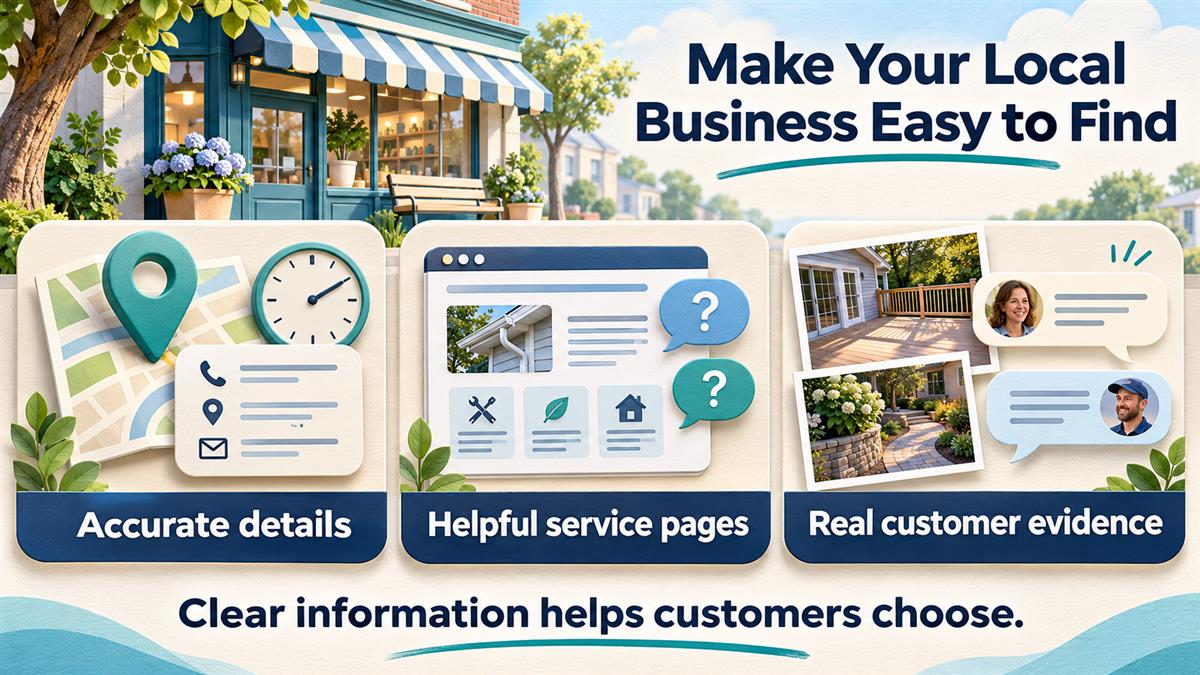
Start with the facts a customer needs before calling or travelling. Review your website, business profiles and the important directories you actually use. Check your business name, phone number, address or service area, opening hours and booking links.
Google recommends complete, accurate Business Profile information and current opening hours. It describes local ranking in terms of relevance, distance and prominence. Those are Google local-search principles, not a published formula for every AI platform. Read Google’s local ranking guidance.
Pay special attention to information that changes:
- Holiday hours and temporary closures.
- New phone numbers or a relocated premises.
- Services you have stopped offering.
- Appointment requirements and booking availability.
- Areas you can realistically serve.
For a service-area business, describe the coverage honestly. Do not imply that you have a staffed branch in every neighbourhood you visit.
2. Explain each important service clearly
A page that says “quality solutions at affordable prices” gives a customer little to compare. Explain what you do, who it is suitable for, what is included and what someone should expect when they contact you.
Consider a hypothetical appliance repair business. Its washing-machine repair page could explain the types of faults it assesses, the areas it covers, how appointments work and whether an inspection fee applies. If it cannot promise a same-day visit, it should explain that availability must be confirmed.
A useful local service page answers five questions:
- What problem do you help with?
- Where is the service available?
- What does the service include or exclude?
- What affects the price and timing?
- How can the customer enquire or book?
Publish actual prices when appropriate. Where a quotation is necessary, explain the factors involved rather than inventing a starting price simply to attract clicks.
3. Answer questions with a local purpose
Use questions from phone calls, messages and in-person conversations to plan your content. The most valuable topics often involve details that a generic industry article cannot answer.
A restaurant could explain dietary options, parking and reservations for larger groups. A salon could describe consultation requirements and the treatments it offers. A home-service company could explain access requirements for apartment buildings and what customers should prepare before a visit.
Put these answers where people need them: on the relevant service, location or booking page. Write a separate guide when the topic needs more explanation. Start with a direct answer, then add useful conditions and examples.
Avoid producing dozens of nearly identical pages with only the neighbourhood name changed. Give each location page a reason to exist, such as genuine branch details, distinct services or relevant project examples.
4. Show real work and relevant experience
Local businesses often have a strong advantage: first-hand knowledge of the customers and places they serve. Make that knowledge visible through original photographs, accurate service descriptions and examples of completed work.
For a project example, describe the customer’s problem, your scope and the outcome you can support. Obtain permission before publishing identifiable customer details. If you have no reliable performance data, explain the work without attaching invented numbers.
Introduce the people behind the service and describe relevant qualifications accurately. A named professional explaining a practical issue gives a reader more context than an anonymous paragraph filled with claims about being the best.
Ask customers for honest reviews through the platforms you use, and respond constructively. Reviews are useful evidence for prospective customers, but there is no universal review count that guarantees AI-search inclusion.
5. Keep your website accessible and easy to use
A detailed page cannot help someone if it fails to load, hides the important text or makes booking impossible on a phone. Test the customer journey on a real mobile device: read a service page, tap the phone number and submit a clearly labelled test enquiry.
Google says that established SEO practices remain relevant to its AI search features and that no additional special optimization is required. Its guidance is available in AI features and your website.
For ChatGPT search eligibility, OpenAI advises allowing OAI-SearchBot access and ensuring your host or content delivery network permits its published crawler IP ranges. Access makes a site eligible; placement remains unguaranteed.
Ask your developer to check accidental indexing restrictions, broken pages, crawler blocks and important content that appears only in images. Review existing structured data for accuracy before adding more. A special plugin or file should not take priority over fixing missing information and broken enquiry forms.
6. Build useful connections beyond your website
Maintain the local and industry profiles that your customers use. Relevant associations, supplier directories and genuine local coverage can give people additional ways to discover and verify your business.
Choose relevance over volume. An accurate listing in a useful industry directory is a more sensible investment than hundreds of low-quality listings. Do not buy fabricated reviews or create misleading mentions to imitate local popularity.
When a partner describes your business incorrectly, request a correction. Consistent facts help customers avoid confusion, even when the eventual discovery happens through a third-party page.
7. Track enquiries as well as visibility
Choose a small set of realistic local questions to monitor. Include a service and location, then add a requirement a buyer would genuinely care about. Keep a record of the question, date, platform, business mentions and cited pages.
Treat each result as an observation rather than a permanent ranking. Different questions, locations and circumstances can produce different answers.
Review website referrals when analytics captures them, but also track calls, bookings and qualified enquiries. Ask customers how they found you and record their answers separately from measured traffic. This helps you identify whether visibility is bringing relevant business rather than simply generating mentions.
Where should a local business start?
Begin with one high-value service and the area you genuinely serve. Correct its business information, improve the service page, answer the most common questions and add a relevant example of your work. Then test the contact or booking process.
Once those basics are reliable, expand to other services and review what customers still need to know. A manageable, accurate website is a stronger foundation than a large collection of repetitive pages.
Velocity Consultancy can help businesses review their website structure, local information and content. Start with a clear view of the services you want customers to discover, then build a practical plan around those needs. Contact our team to discuss your priorities.
Frequently Asked Questions
Can a small local business appear in AI search results?
Yes. A local business can be relevant to a specific service, location or customer requirement. Accurate information and useful pages support discovery, but no business can guarantee selection in an AI-generated answer.
Is a Google Business Profile enough for AI search visibility?
A Business Profile is important for Google’s local ecosystem, but it is not a universal submission system for every AI platform. A website gives you space to explain your services, experience, pricing factors and booking process in more detail.
Do I need a separate page for every area I serve?
Not necessarily. A clear service-area page may be enough. Create separate pages when there is meaningful location-specific information to share, rather than copying the same text and swapping place names.
Does adding FAQ schema guarantee an AI recommendation?
No. Helpful questions and answers should serve readers first. Structured data should accurately describe the content, but adding it does not guarantee that an AI platform will recommend or cite your business.
How long does it take to get discovered through AI search?
There is no dependable universal timeline. Access, discovery and selection are separate issues. Focus on completing useful improvements and monitoring relevant enquiries rather than promising visibility by a fixed date.
Should I stop traditional local SEO and focus only on AI?
No. Maintain accurate listings, useful website pages and a working customer journey. Add AI-search monitoring to your existing marketing activity and judge progress by the quality of the business it helps generate.


 15+ Years Of Expertise
 100% Confidential