

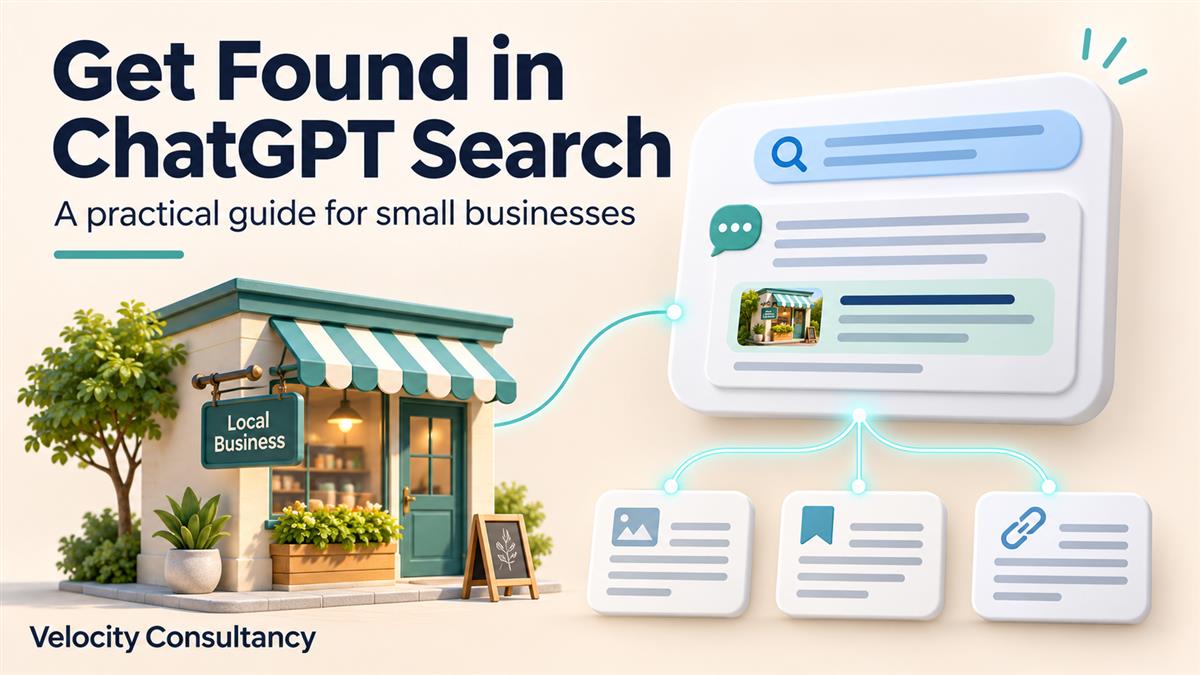
Small businesses can improve their chances of appearing in ChatGPT search by making their websites accessible, answering real customer questions and publishing accurate, useful information. There is no guaranteed way to get featured. The practical goal is to become a relevant source that a prospective customer can find, verify and act on.
You do not need to begin with dozens of new articles. Start with your most important service page, the questions buyers ask before contacting you, and the technical settings that affect access to your website.
This guide explains what OpenAI documents about search eligibility, then offers practical website and content improvements for a small-business team. The recommendations are an editorial action plan, not a list of confirmed ChatGPT ranking factors.
What does getting featured in ChatGPT search mean?
A business can be mentioned in an answer, have its website cited as a source, or appear through a third-party page discussing it. These are different outcomes. A mention without a link is not a website referral, and a citation is not automatically a recommendation.
ChatGPT can search the web and link to sources. OpenAI says its search ranking considers multiple factors to find relevant, reliable information, and that placement is not guaranteed. See OpenAI’s explanation of ChatGPT web search.
For a small business, useful visibility might mean being found when someone compares services in your area or asks a question your team can answer particularly well. Choose those customer needs before choosing keywords. If the terminology is new, our guide to AI search optimization provides broader background.
1. Check that search crawlers can reach your website
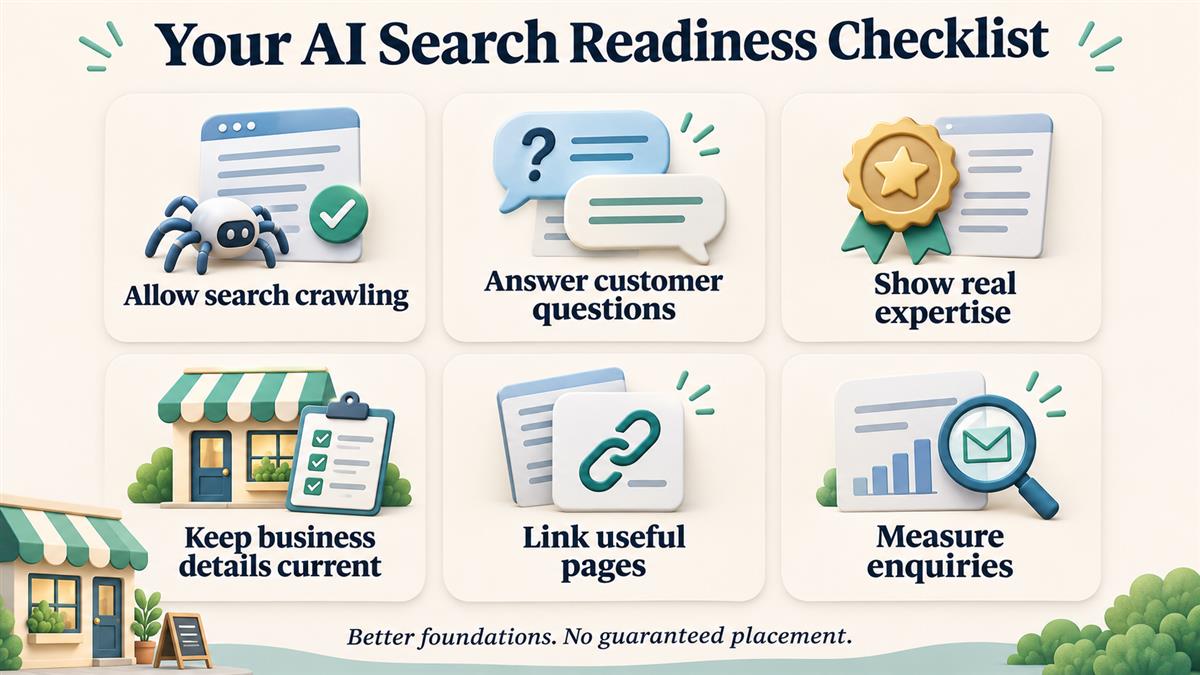
OpenAI identifies OAI-SearchBot as its search crawler. Its documentation recommends allowing that crawler in your robots.txt rules and allowing requests from its published IP ranges through your hosting or content delivery network.
GPTBot has a separate purpose: gathering material that may be used for model training. The two settings are independent, so allowing search access does not require allowing training access. ChatGPT-User handles certain user-triggered visits and is not the control for search inclusion. These distinctions are documented in OpenAI’s crawler overview.
Ask your developer to check the pages that matter, rather than simply declaring the entire site accessible:
- Can a visitor open the service page without logging in or completing a challenge?
- Does the page return successfully rather than redirecting repeatedly or showing an error?
- Are its important facts available as readable page content rather than only inside an image?
- Do your security tools block legitimate crawler requests?
- Are there accidental indexing restrictions left over from website development?
Keep these checks within a wider technical SEO review. Do not disable security controls wholesale; have your developer investigate specific access failures.
2. Build pages around questions customers actually ask
Begin with enquiries, sales conversations and support requests. Which questions come up before someone is ready to buy? A focused answer to a specific problem is more useful than another general article about why your industry matters.
For example, an independent web design company might explain what is included in a business website project, what affects its price and what the client needs to supply. A local maintenance company might explain its service area, appointment process and common exclusions.
Use the customer’s question as a heading where it fits naturally. Give a direct answer first, then explain conditions, examples and limitations. A useful service page should cover:
- The service, intended customer and areas you genuinely serve.
- What is included and what needs a separate quotation.
- The process and information needed to get started.
- Pricing factors or accurate prices where you can publish them.
- Relevant experience and a clear contact route.
This answer-focused approach is part of our answer engine optimization services. It is a way to improve the usefulness of a page, not a special formatting trick that guarantees a citation.
3. Add evidence that only your business can provide
A small business often has valuable knowledge that never reaches its website. Turn recurring customer problems and completed work into useful, permission-cleared examples.
Instead of saying “we deliver excellent results,” describe a project’s starting problem, the work completed and the outcome you can substantiate. If you do not have reliable performance measurements, show the deliverables and explain the decisions. Do not invent percentages or imply that a design screenshot proves revenue growth.
Other useful material includes original photographs, product specifications, named team expertise, practical checklists and explanations of common trade-offs. Attribute technical advice to the person who reviewed it when appropriate. Update a page when its information changes, rather than changing the date alone.
4. Make your business identity easy to verify
Review your business name, contact details, service area and website address across the channels you control. Correct outdated opening hours, old phone numbers and conflicting descriptions. Keep an accessible About page and a clear Contact page.
For a local business, maintain the profiles and industry listings that actual customers use. Seek genuine reviews and relevant coverage because they help people assess your business. Do not treat a particular directory, review count or number of brand mentions as a proven ChatGPT ranking requirement.
A useful hypothetical example is a Mumbai interiors studio that specialises in compact offices. A page showing its actual project types, service boundaries, process and approved portfolio is more informative than repeating “best interior designer” across a dozen near-identical location pages.
5. Connect your helpful content with internal links
A reader who learns about a problem should be able to find the service that solves it. Link educational articles to relevant service pages, and link service pages to supporting examples or detailed guides. Use descriptive wording that explains the destination.
For example, a guide about planning a website can link to a page about web design scope. Avoid linking every article to every service, or repeating the same keyword-heavy anchor unnaturally. Each link should provide a useful next step.
If your business has a new website, read our AI SEO guide for startups and new domains alongside this checklist. Build the essential business pages first, then expand the topics you can cover with real expertise.
6. Use structured data accurately, without treating it as a shortcut
Structured data is a machine-readable description of page information. Relevant organization, business or article markup can make that information explicit. It should describe what the page actually contains and remain consistent with the visible content.
Review what your website or SEO plugin already generates before adding another copy. Do not add invented ratings, unsupported awards or services you do not provide. Treat schema as website housekeeping, not a promise of ChatGPT placement. Likewise, do not prioritise a special “AI-ready” file over fixing inaccessible pages or missing service information.
7. Measure useful outcomes, not a single answer
Create a small set of realistic buyer questions, such as “What should I compare when choosing a website agency for a small business?” and a location-specific version where relevant. Use web search, record the date and question, and note whether your business was mentioned, whether your own page was cited and whether the description was accurate.
OpenAI documents that search may use partner providers and location information. A single response is therefore not a fixed leaderboard for every customer. Repeated checks are observations, not proof that one edit caused a ranking change.
Alongside these checks, review referral traffic from ChatGPT when your analytics captures it. Compare landing pages, completed enquiries and qualified opportunities. Ask new customers how they found you, and record that separately from measured referrals. This gives you a more useful picture than collecting screenshots of brand mentions alone.
A practical 30-day plan for a small business
| When | Priority | Deliverable |
|---|---|---|
| Week 1 | Review access and business facts. | A short list of technical issues and corrected contact or service information. |
| Week 2 | Improve one important service page. | Clear scope, buyer questions, evidence and a working enquiry route. |
| Week 3 | Create one genuinely useful supporting article. | An original guide linked to the relevant service and supporting examples. |
| Week 4 | Review visibility and enquiries. | A baseline log of citations, referrals and lead quality, plus the next improvements. |
This is a work schedule, not a deadline for appearing in ChatGPT. Start with a manageable set of pages and improve them based on what you learn.
Frequently asked questions
Can a small business appear inZ ChatGPT search?
Yes, a small business can be a relevant source for a specific service, location or customer question. Eligibility and usefulness matter, but neither guarantees that its website will be selected.
Does allowing GPTBot guarantee a ChatGPT mention?
No. GPTBot concerns potential training use; OAI-SearchBot is the search crawler. Giving access is not a placement guarantee.
How long does it take to get featured?
There is no reliable universal timetable. Technical changes, discovery and selection are different stages. Avoid treating a crawler visit or a completed optimization project as a promise of immediate visibility.
Should I replace traditional SEO with ChatGPT optimization?
Keep maintaining your website’s search fundamentals. Readable pages, clear services, useful content and internal links serve customers across channels. Add AI-search observations to your reporting rather than abandoning your existing acquisition channels.
How much new content should I create?
Start with the gaps that prevent a buyer from understanding your service. Improving one important page and writing one evidence-based guide is a practical starting point for a small team. Expand when you have something useful to add.
Make your business easier to discover and assess
The most useful starting point is a website that explains your business clearly and supports its claims. Combine that with appropriate crawler access, original expertise and a sensible measurement process.
Velocity Consultancy’s AI search optimization services cover areas such as technical audits, content structure and business information. Contact our team to discuss your website, the questions your customers ask and a practical improvement plan.


 15+ Years Of Expertise
 100% Confidential