

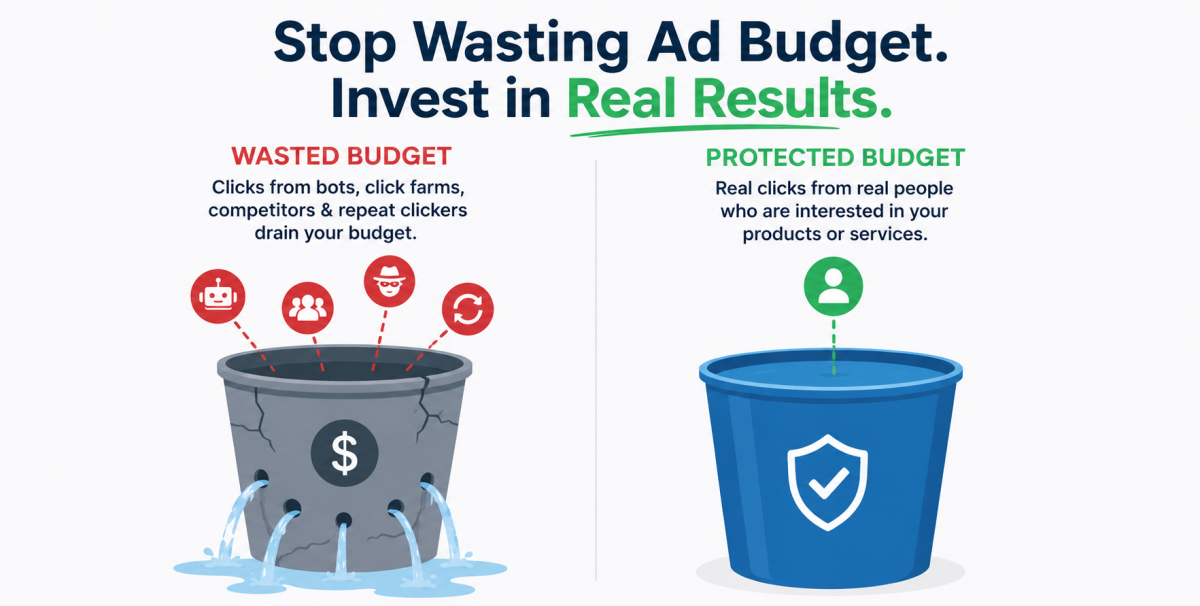
If you run a business and pay for online ads, there is a number you probably don’t know. It’s the percentage of your ad spend that disappears into clicks from sources that will never become a customer. For most accounts I look at, that number sits somewhere between 15 and 25 percent.
That’s not a small leak. That’s a hole in the bucket. And the bucket holds the budget you worked hard to put aside for growth.
I’ve spent enough time looking at client dashboards to spot the pattern instantly. The conversion rate that should be improving stays flat. The cost per acquisition creeps up every quarter. The same campaigns that used to perform are suddenly underwhelming. People blame the algorithm, the creative, the audience. The real culprit is usually click fraud.
So What Is Click Fraud Really
Click fraud is the catch-all term for clicks on your ads that didn’t come from real, interested potential customers. There are a few different sources, and each one drains budget in its own way.
- Automated bots that browse the web pretending to be people. Some are crude. The more advanced ones can mimic mouse movements, scroll behaviour, even simulated reading time.
- Click farms where real workers sit at phones tapping ads for hours. The traffic looks human because, technically, it is.
- Competitor clicks where a rival burns through your daily budget so their own ad gets the impressions.
- Repeat clickers who click your ad multiple times a day without ever buying. They cost you money and pollute your retargeting audiences.
Add it all up, and you get an industry that the major ad networks are reluctant to talk about. They make their money on clicks, after all.
How to Tell If It’s Happening to You
You don’t need an audit team to start looking. Pull up your last 90 days of data and check for these signals.
Conversion rates dropping while CTR holds steady
This is the classic tell. More clicks should mean more conversions, all else equal. If clicks are up and conversions are flat or falling, the new clicks weren’t customers.
Sudden traffic from places that don’t match your targeting
Filter your geo report. If you target specific cities and you’re seeing traffic from regions outside that, dig in. Some of it might be VPN users you can ignore. Most of it is worth questioning.
Hyperactive sessions with zero engagement
Look at session duration and page depth from your paid channels. Bot traffic loves to bounce. If a campaign drives clicks but the visitors don’t scroll, don’t engage, and don’t come back, you’re paying for nothing.
The Practical Fixes I Recommend
My advice to clients always starts with the free stuff before moving to paid tools. There’s no point spending more if you haven’t done the basics.
Audit your placements
Especially if you run anything beyond search. Display, video, and partner networks are where bad placements hide. Cut anything that drives traffic without conversions for more than a couple of weeks.
Use exclusion lists religiously
Every ad platform lets you exclude IPs, audiences, placements, locations, demographics. Use them. Build the habit of pruning weekly.
Tag your conversion paths properly
If you can’t see where customers come from versus where clicks come from, you can’t tell the difference. Set up tracking that connects clicks all the way through to lifetime value, even if it’s basic.
Invest in a dedicated protection tool
Once you’ve done the manual work, the next step is automation. There’s a category of software built specifically for this. A click fraud protection platform sits between your ads and the traffic, analysing every single click in real time. It looks at behavioural signals (not just blacklists, which fraudsters easily get around) and blocks bad traffic before it costs you anything. The good ones also give you reporting so you can see exactly what was caught and what would have happened otherwise.
For most clients I work with, the savings from blocking invalid clicks pay for the tool within the first month. After that it’s pure margin recovered.
The Real Cost Is Bigger Than the Wasted Spend
Here’s what most advertisers miss. The direct loss (the money you paid for fraudulent clicks) is the obvious part. The bigger problem is what those clicks do to your campaign data.
Modern ad platforms use machine learning to decide who to show your ads to. They learn from the clicks and conversions your campaigns generate. When a chunk of those clicks come from bots and click farms, the algorithm learns to look for more users like that. Your targeting gets worse over time, even as your budget stays the same.
Clean traffic in equals smart targeting out. Polluted traffic in equals algorithmic confusion. The compounding effect over six or twelve months is what really hurts.
Where to Start This Week
If you’re reading this and wondering whether your campaigns are affected, the answer is almost certainly yes to some degree. The question is how much.
Block out an hour. Open your ad platforms. Pull the reports I mentioned above. See if any of the patterns match what you’re looking at. Most of my clients have a small heart attack moment when they spot the first sign.
After that, decide whether the leak is big enough to justify proper protection. For anyone spending more than a couple of thousand a month on paid traffic, my answer is always yes.
Your competitors who already figured this out are spending the same budget you are. They’re just spending it on real customers.


 15+ Years Of Expertise
 100% Confidential